





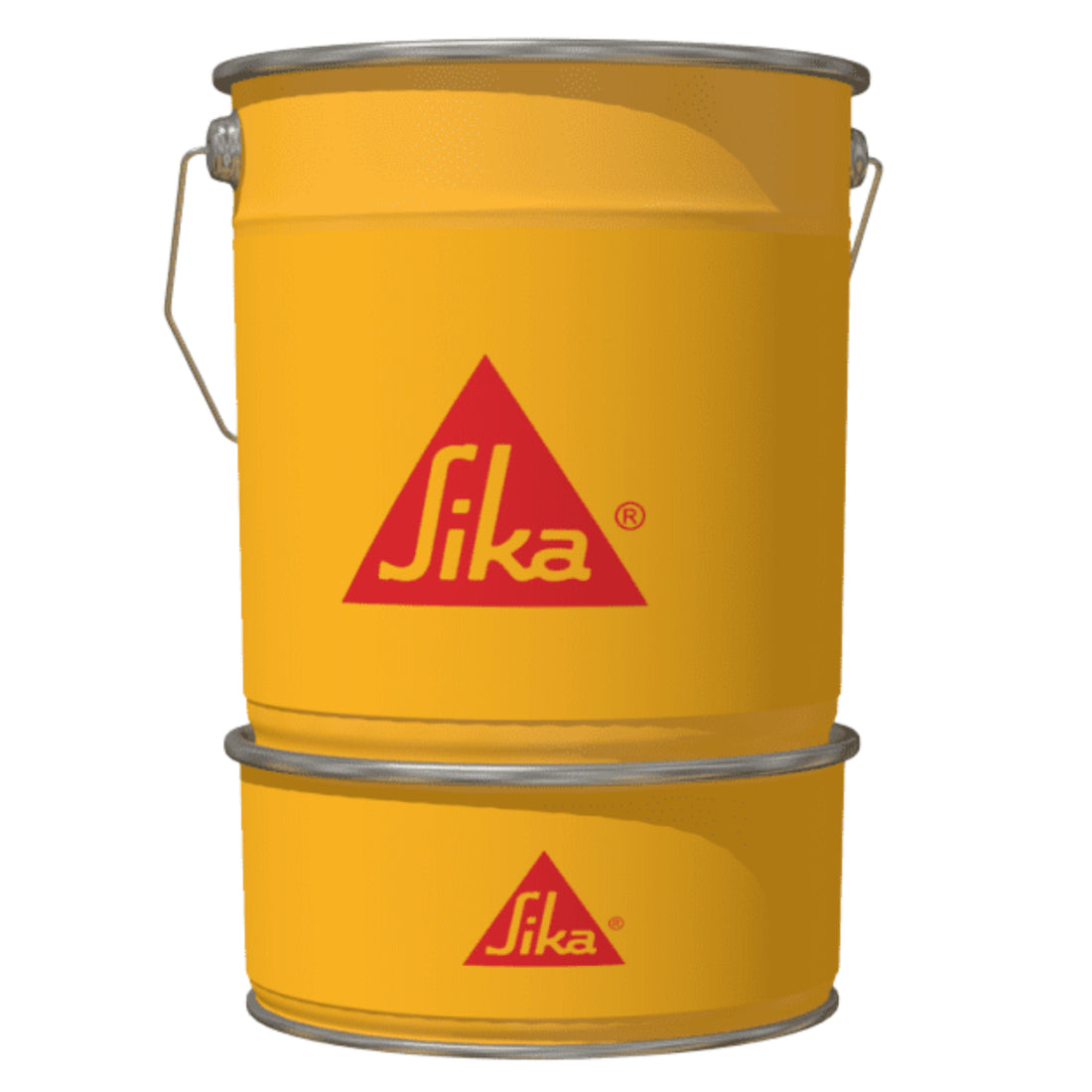

Concrete and steel exposed to aggressive chemicals require more than a standard decorative coating. Sikagard®-63 N is a two-part novolac epoxy protective coating designed to provide a high-build, liquid-impervious barrier on prepared concrete, cementitious and metal substrates in specified chemical-exposure environments.
For bunds, tanks and industrial containment
Suitable applications include selected chemical containment and mixing tanks, bund linings, silos, sludge tanks and industrial process areas. It can also be used as an anti-corrosion coating on appropriately prepared steel in specified food-processing, wastewater and chemical facilities. Its low-VOC, high-build formulation can be applied by brush, roller or airless spray.
Verify chemical resistance before specifying
Chemical compatibility depends on the substances, concentrations, exposure and service temperatures; select the full coating system against the project requirements rather than assuming resistance to all chemicals. Sika specifies approximately 0.25–0.4 kg/m² per layer and 175–300 microns per layer under published conditions. This listing contains a 10 kg Part A + Part B kit (8.7 kg + 1.3 kg). Use only on correctly prepared substrates and follow Sika's current Australian product data sheet for mixing, moisture, temperature and overcoating limits.
Specified potable-water contact: Sika lists AS/NZS 4020:2018 approval for use in contact with drinking water. The actual chemical resistance and coating system must still be checked for the application; this approval does not imply suitability for all chemical or food-contact exposures.
- Concrete and stone
- Cementitious mortars and render
- Epoxy-cement and epoxy resin surfaces
- Prepared steel
Sikagard®-63 N Physical Properties
| Property | Value |
|---|---|
| Chemistry | Two-part novolac epoxy resin |
| Kit | 10 kg (A 8.7 kg / B 1.3 kg) |
| Mixed density | Approximately 1.44 kg/L (+23°C) |
| Consumption | Approximately 0.25–0.4 kg/m² per layer |
| Pot life at +20°C | Approximately 20 minutes |
| Overcoating at +20°C | Approximately 5 hours minimum / 2 days maximum |
| Full cure at +20°C | Approximately 9 days |
| Concrete adhesion | >1.5 N/mm² (ISO 4624) |
| Potable-water contact approval | AS/NZS 4020:2018, subject to applicable system |