
Download Product Data
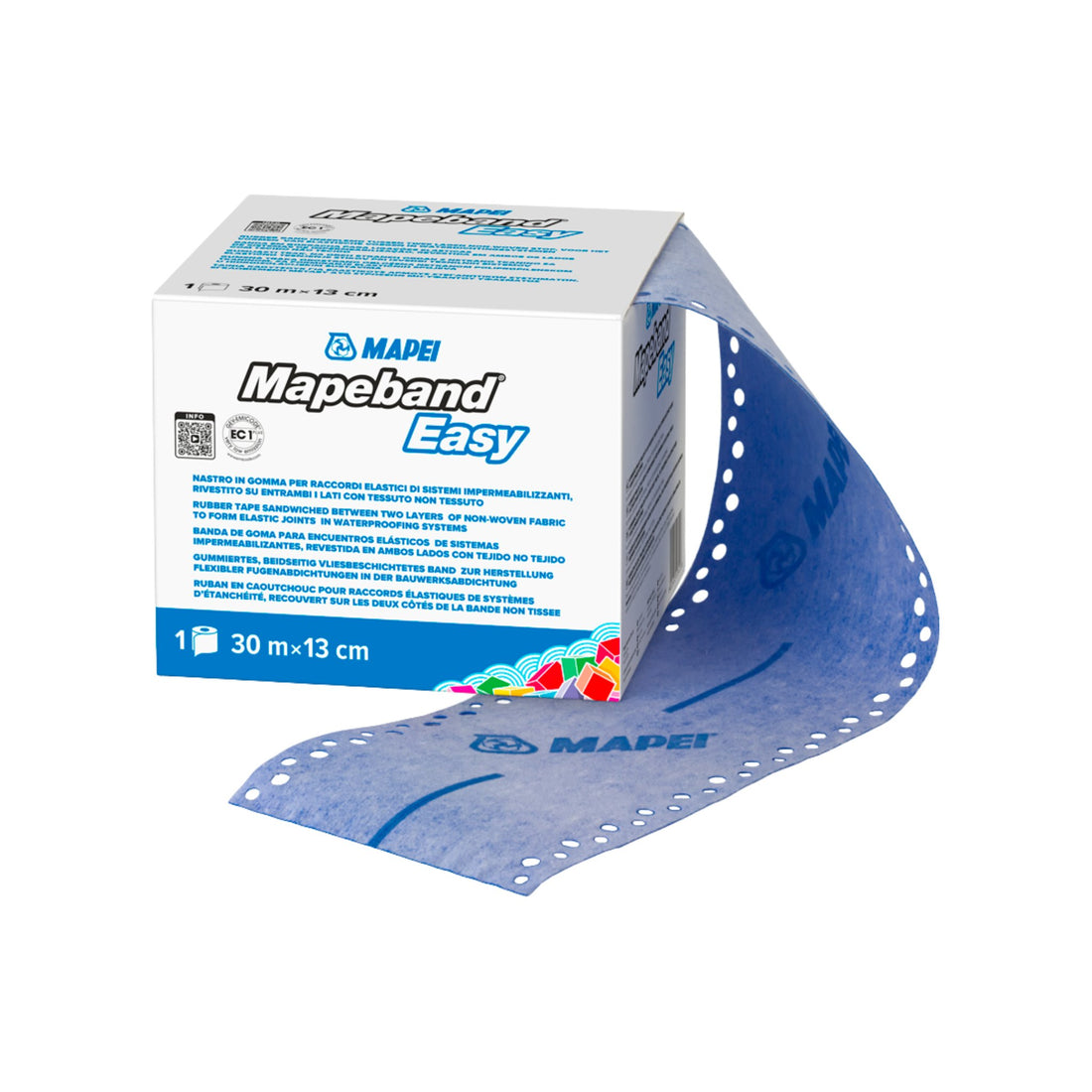
For waterproofing wall-to-floor junctions, internal wall corners, and external balcony control joints, Mapeband Easy Joint Tape forms a reliable, elastic barrier that accommodates structural movement. The tape features a vapour-proof and waterproof rubber core sandwiched between two layers of alkali-resistant, non-woven polypropylene fabric. This composite structure allows direct bonding with liquid waterproofing membranes, ensuring a continuous barrier across critical expansion zones.
How it works
Mapeband Easy Joint Tape relies on a multi-layer mechanism to bridge joints. The central rubber core provides the waterproofing and vapour-proof barrier, while the outer non-woven fabric layers provide a textured surface for mechanical adhesion. Perforations along the tape edges allow liquid membranes to wet through and secure the tape to the substrate. It is compatible with multiple Mapei waterproofing systems, including Mapelastic, Monolastic, Mapegum WPS, and Aquaflex Roof. Because the outer non-woven layers are seamless, joins between running lengths of tape are bonded directly using the same waterproofing membrane applied to the rest of the installation.
Numbers that matter
- 315% elongation at failure (EN ISO 527-1): High elasticity to absorb structural movement in wall-to-floor junctions and outdoor terraces without tearing.
- 0.68 mm thickness (EN 1849-2): Low-profile build-up that prevents bulkiness under subsequent tile, stone, or mosaic installations.
- 5 cm minimum overlap: The required joint overlap to maintain waterproofing continuity when joining two running lengths of tape.
- 45 N/15 mm tensile strength (EN ISO 527-3): Mechanical resistance to withstand stresses across moving joints.
Where to use it
- Waterproofing corners between adjacent walls and between walls and floors.
- Waterproof elastic control joints on terraces, balconies, and external screeds.
Limitations
- To form a seal in corners and around edges, use the pre-formed 90° and 270° pieces from the Mapeband Easy range.
- To form a seal around pipework, use the special Mapeband Easy templates.
Installation
Apply a coat of the chosen waterproofing product along the corners, edges, or expansion joints. Position the tape flat into the wet membrane, ensuring there are no folds, creases, or trapped air bubbles, and verify that the liquid membrane squeezes through the perforated edges to lock the tape in place. When bridging control joints in screeds on terraces or balconies, centre the tape directly over the joint.
When the finished surface is to be covered with tiles, stone, or mosaics, apply the waterproofing membrane over the edges of the tape but leave the central section (marked with a dotted line) uncoated. This allows the joint to be located during tiling so that a matching movement joint can be placed directly above it in the tile layer. If reinforcing mesh is used in the membrane system, always break the mesh at the edges of the tape so the rubber core remains free to move.
Frequently asked questions
Is Mapeband Easy compatible with all liquid waterproofing membranes?
Mapeband Easy is compatible with the Mapelastic range, Monolastic, Mapegum WPS, and Aquaflex Roof products. Always confirm compatibility if using third-party membranes to ensure proper bond and system performance.
Do I need a primer before applying Mapeband Easy?
Primer is recommended for highly absorbent or dusty substrates. This improves the adhesion of the waterproofing membrane beneath the tape. For stable, clean concrete or existing membranes, priming is typically not required.
How should I handle overlaps between sections of Mapeband Easy?
Overlap sections by at least 50 mm. Embed the tape fully with the chosen waterproofing product, ensuring a continuous, watertight seal that accommodates movement without separation.
Can Mapeband Easy be tiled over?
Yes, Mapeband Easy can be tiled over. It can be fully coated with the waterproofing product, or the central dotted area can be left exposed to mark control joints for the tile layout.
Applications and benefits
| Application | Key benefit | Primary trades |
|---|---|---|
| Wall-to-floor junctions | Creates a flexible, watertight seal at critical wet-area corners. | Waterproofers, Tilers |
| Balcony and terrace control joints | Maintains waterproofing integrity under substrate movement with >300% elongation. | Waterproofers, Builders |
| Pipe and drain penetrations | Seals around penetrations to prevent leaks in wet areas. | Plumbers, Waterproofers |
| Wet area wall corners | Eliminates failure points in showers and bathrooms with elastic, seamless coverage. | Tilers, Renovators |
| Expansion joint bridging | Absorbs structural movement, preventing cracking of liquid membranes at stress points. | Specifiers, Remedial Contractors |
Applying Mapeband Easy: Enhanced Protocols & Best Practices
-
1. Prepare the Surface
Clean all junctions, corners, and control joints. Ensure surface is sound, dry, and free of dust, grease, and laitance. Prime as required for porous surfaces.
Pro Tip: Use a moisture meter to verify substrate dryness and avoid membrane blistering. -
2. Apply First Coat of Membrane
Brush or roller apply a continuous coat of the selected liquid membrane (e.g., Mapelastic, Mapegum WPS) along corners, edges, and over joints to receive Mapeband Easy.
Timing: Embed tape while the membrane is still wet for full adhesion through perforations. -
3. Install Mapeband Easy
Press Mapeband Easy into the wet membrane, ensuring no folds or trapped air. Overlap joints by at least 50 mm and embed fully.
Corners
Use pre-formed 90° and 270° pieces for internal/external corners to ensure a watertight seal.
Pipes
Install Mapeband Easy pipe templates to seal around penetrations and prevent leaks.
Pro Tip: Use a roller to press tape firmly, forcing membrane through the perforations for a fully bonded edge. -
4. Apply Second Coat
Once tape is secured, apply additional membrane over the edges and across the surface to create a continuous waterproof barrier.
Pro Tip: Break reinforcement mesh at tape edges to allow independent movement of the joint without compromising membrane integrity.
Product limitations
- Not for: Direct, extended exposure to UV without a protective membrane or tile finish. Mapeband Easy must always be part of a complete waterproofing system.
- Not for: Application to damp or contaminated surfaces. Ensure the substrate is fully dry and free from laitance, grease, and debris prior to installation.
- Caution: Do not stretch excessively during installation. This may reduce the tape's elongation performance and compromise joint sealing.
Safety and handling
Personal protective equipment
Wear protective gloves and safety goggles during handling and installation, especially when used with liquid membranes or primers, to prevent irritation.
Ventilation
Work in well-ventilated areas when using with liquid membranes or primers. Ensure good airflow to prevent the build-up of vapours indoors.
First aid
- Eyes: Flush with clean running water for several minutes. Remove contact lenses if present. Seek medical attention if irritation persists.
- Skin: Wash with soap and water. Remove contaminated clothing. If irritation develops, seek medical advice.
- Inhaled: Move affected person to fresh air. Seek medical advice if symptoms such as dizziness or headache persist.
- Swallowed: Rinse mouth thoroughly with water. Do NOT induce vomiting. Seek immediate medical attention.
Storage and disposal
Store rolls in a cool, dry place away from direct sunlight and ignition sources. Dispose of product and packaging according to local regulations.
Substrate guide
Proper substrate preparation is critical for system integrity and long-term performance. This guide outlines requirements for common substrates.
Concrete and screeds
Surface prep: Ensure the substrate is fully cured, clean, dry, and free of laitance, dust, and contaminants. Control joints must be clearly defined. Remove loose material and vacuum before membrane application.
Primer: Optional. Prime highly absorbent or dusty concrete with the waterproofing membrane manufacturer’s recommended primer for uniform adhesion.
Masonry and renders
Surface prep: Repair all cracks and voids. The substrate must be sound and smooth. Remove any loose render, dirt, or efflorescence.
Primer: Optional. Apply a penetrating primer to stabilise friable surfaces prior to applying the waterproofing membrane.
Existing membranes
Surface prep: Ensure the existing membrane is fully bonded and free from blisters or delamination. Clean and abrade glossy surfaces to promote adhesion for the new membrane.
Primer: Not required. Apply the new waterproofing membrane directly after surface cleaning and mechanical abrasion.
Mapei Mapeband Easy Joint Tape Physical Properties
| Property | Value |
|---|---|
| Type of Material | Rubber core with alkali-resistant non-woven polypropylene fabric |
| Thickness | 0.68 mm |
| Weight | 285 g/m² |
| Tensile Strength | 45 N/15 mm |
| Elongation at Failure | 315 % |
| VOC Certification | EMICODE EC1 Plus (very low emission) |
| Compatible Waterproofing Products | Mapelastic range, Monolastic, Mapegum WPS, Aquaflex Roof |
| Packaging | Roll 30 m x 130 mm |
| Primary Applications | Corners between adjacent walls, Wall-to-floor junctions, Elastic control joints on terraces and balconies |
| Edge Design | Perforated edges to improve wetting and bond with waterproofing products |
| Central Marking | Dotted centre line to align control joints when tiling |
