





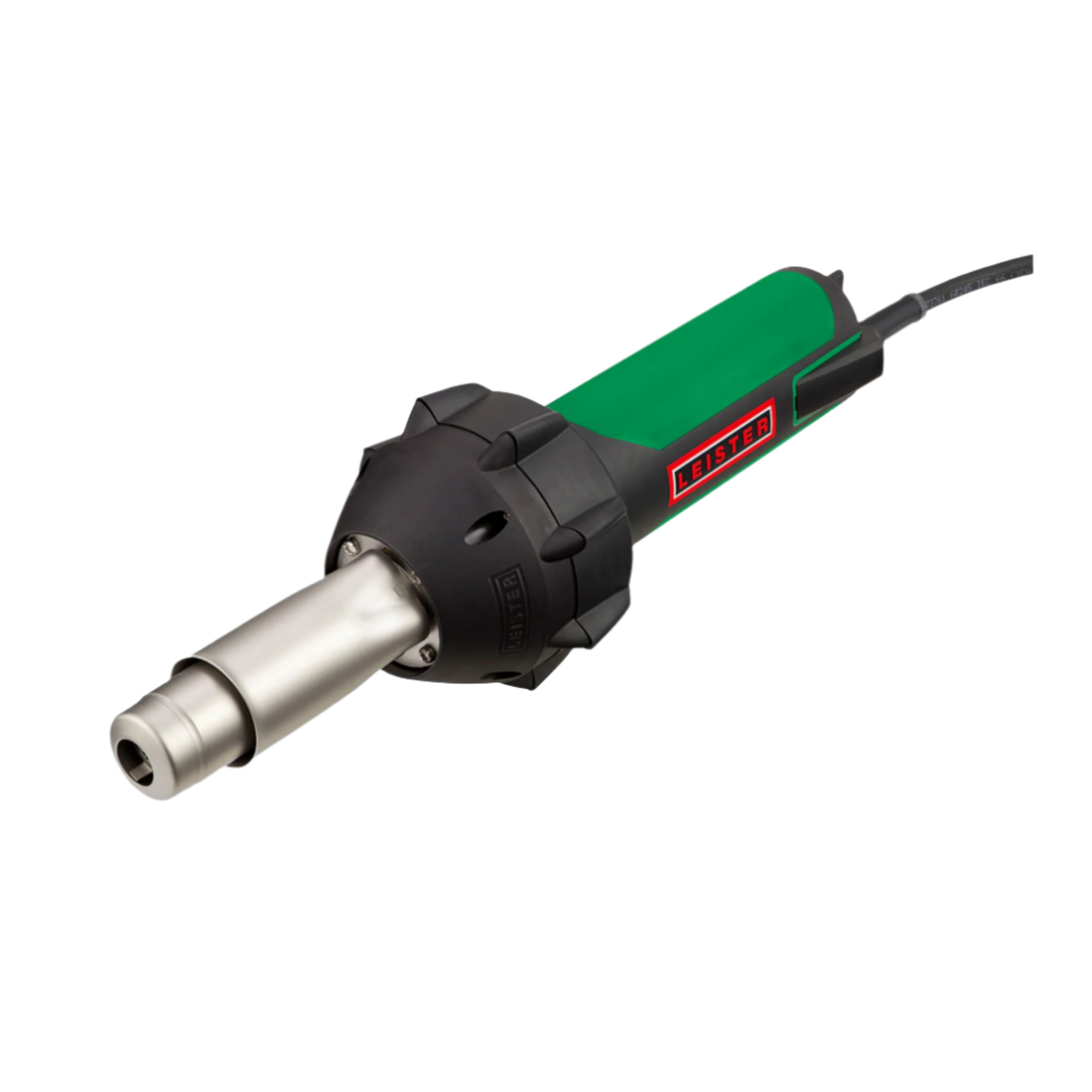


The Leister TRIAC ST is the analogue workhorse of membrane welding: 1600W, stepless heat from 40 to 700 degrees, and 0.99kg in the hand, which is why roofers pick it for a full day of overlap welding.
No digital screen to fail: the Swiss analog control shrugs off cold starts and dirty generator power that lock up electronic guns.
Frequently asked questions
Is the TRIAC ST compatible with Australian 10A power outlets?
Yes, the TRIAC ST operates at 230 V / 1600 W and ships with a 10A, 3-pin AU plug. This makes it fully compliant with standard Australian jobsite and workshop power outlets.
What materials can this heat gun weld?
The TRIAC ST is designed for welding thermoplastics such as PVC, TPO, HDPE, LDPE, PP, and coated fabrics. It is not suitable for non-thermoplastic materials like metals or composites.
Does the TRIAC ST have adjustable airflow?
No, the TRIAC ST provides a fixed airflow of 240 l/min. This consistent airflow ensures stable heat delivery without requiring separate fan control.
Can I use TRIAC AT nozzles with the TRIAC ST?
Yes, the TRIAC ST uses a ø31.5 mm (M14) nozzle connection. This is compatible with over 80 Leister welding and forming nozzles, including standard attachments for the TRIAC AT.
Is the TRIAC ST suitable for continuous site work?
Substrate guide
Understanding substrate preparation and heat settings is key for a strong weld. This guide outlines standard approaches for common thermoplastics welded with the Leister TRIAC ST.
PVC (Polyvinyl Chloride)
Surface prep: Clean the surface with a dry cloth before welding. Ensure it is free of dust and contaminants.
Welding range: Set the tool between 500–600 °C. Use a slit nozzle for seams.
Primer: Not required. The TRIAC ST welds PVC directly, achieving excellent fusion with standard Leister overlap nozzles.
TPO (Thermoplastic Polyolefin)
Surface prep: Clean the material with isopropyl alcohol (IPA) before welding to remove any surface oils or dirt.
Welding range: Recommended temperature is 550–620 °C. Use a slit or wide-slot nozzle. Apply steady pressure and maintain an overlap technique. Test seam strength after cooling.
Primer: Not required.
HDPE / LDPE (Polyethylene)
Surface prep: Ensure the surface is clean and dry. Use a wide-slot nozzle.
Welding range: Set to 580–650 °C. Polyethylene softens quickly; test a small area first. Keep the heat gun moving continuously to avoid surface burns.
Primer: Not required.
Coated Fabrics / Tarpaulins
Surface prep: Gently clean the fabric with a soft cloth to remove dirt without damaging the coating.
Welding range: Approximately 520–580 °C. Use a flat or slit nozzle with a low angle to prevent overheating edge coatings. Suitable for banners, awnings, tents, and truck tarps.
Primer: Not required.
Leister Triac ST Heat Gun Physical Properties
| Property | Value |
|---|---|
| Voltage | 230 V |
| Power | 1600 W |
| Frequency | 50/60 Hz |
| Temperature Range | 40–700 °C |
| Temperature Setting | Stepless (Analog Dial) |
| Airflow | 240 l/min (Fixed) |
| Air Volume Adjustment | No |
| Static Pressure | 3000 Pa |
| Display | No |
| Outdoor Use | Yes |
| Nozzle Connection | ø31.5 mm / 1.25 in (M14 thread) |
| Length | 338 mm |
| Device Diameter | 90 mm |
| Handle Diameter | 56 mm |
| Weight | 0.99 kg (without cable) |
| Power Cable Length | 3.0 m |
| Noise Emission Level | 67 dB(A) |
| Protection Class | II |
| Plug Type | AU, 3-pin, 10A |
| Approvals | CE, UL, KC, S+ |
| Country Of Origin | Switzerland |