
Skip to content
🚛 Flat Rate Shipping $17.95+ GST For Metro & standard delivery zones! Excludes remote/regional and high-cost postcodes (including parts of QLD, WA, NT & TAS), and bulky or heavy items. Online only. Learn More
11

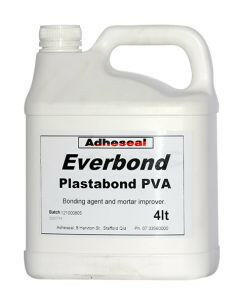
Everbond Plastabond PVA

Everbond Plastabond PVA improves adhesion and strength in mortars, screeds and renders. Mix at 1:1 to 1:10 as a plasticiser, or 4:1 as a bonding agent.

Vendor: Adheseal
SKU: PLASTAB/20
Availability: In Stock
$262.20
$262.20
Prices do not include GST
Shipping & Delivery

Flat-rate shipping $17.95 + GST (metro and standard zones). Excludes remote/regional/high-cost postcodes and certain items (DG, oversized, long-length, or bagged products 15 kg+). If your order includes any of these, we will contact you to arrange additional freight charges. Online purchases only.

For high-strength mortars, floor screeds, renders, and slurries requiring improved adhesion and durability, Everbond Plastabond PVA acts as a dual-purpose bonding agent and plasticising additive. This polyvinyl acetate resin water dispersion modifies sand, cement, and gypsum mixes to improve chemical resistance and lower water permeability while remaining non-corrosive to steel structural elements.

How it works

Everbond Plastabond PVA modifies the cementitious matrix to produce polymer-modified mortars and renders with increased tensile and mechanical strengths. As an additive, it improves mix elasticity to reduce shrinkage cracking and increases resistance to oil, water, abrasion, and mild chemical attack. When applied directly as a surface bonding agent, it creates a high-adhesion keyway to secure new screeds and concrete pours to existing substrates.

Where to use it

  • As an additive: Modifies patching and repair mortars, renders, floor screeds, and slurries to increase bond strength and durability.
  • As a bonding agent: Bonds new concrete and toppings to prepared structural surfaces.
  • Insulation board installations: Improves the adhesion of cementitious renders when applied directly over insulation boards and lightweight panels.

Limitations

  • Polystyrene panels: Do not use Everbond Plastabond PVA for bonding to polystyrene panels. For these substrates, refer to the technical data sheet for acrylic bonding agents.
  • Application temperature: Do not apply when substrate or ambient temperatures are below 5°C or above 35°C.
  • Curing constraint: When used as a surface bonding agent, the topping concrete must be poured while the applied film is still tacky.

Dilution and application

  • As a plasticiser admix: Dilute between 1 part Plastabond to 10 parts water, up to 1 part Plastabond to 1 part water depending on strength requirements. Mix into the concrete or mortar to achieve the desired consistency, typically requiring 7 to 10 litres of the blended liquid per bag of cement.
  • As a bonding agent: Dilute 4 parts Plastabond to 1 part water. Apply to the substrate at an approximate coverage rate of 8 square metres per litre. Pour the concrete over the wet film while it remains tacky.
  • Clean up: Wash tools and remove uncured material immediately using clean water.

Frequently Asked Questions About Plastabond

Q: Can I use Plastabond for external render applications in high-humidity areas?

A: Yes. Plastabond improves both adhesion and water resistance, making it ideal for external renders, even in humid Australian coastal environments. Ensure the bonding coat remains tacky before application for optimal results.

Q: What dilution ratio should I use for patching concrete?

A: For patching mortars, a 1:1 or 1:2 Plastabond-to-water ratio is typically ideal, depending on the flexibility and adhesion required. Always test on a small batch for best performance match.

Q: Is Plastabond suitable for bonding over polystyrene panels?

A: No. For polystyrene substrates, an acrylic-based bonding agent is recommended. Plastabond is optimised for cementitious and porous substrates.

Q: How soon can I apply screed or concrete after bonding coat application?

A: Apply the screed or concrete while the bonding coat is still tacky to ensure proper adhesion. Do not allow the bonding coat to dry completely before placing the overlay.

Applications & Benefits

Product applications, benefits, and relevant trades
Application / Use Case Key Benefit Primary Trades
Concrete repair patching Improves bond strength and reduces cracking Builders, Concreters
Floor screeds Enhances flexibility and abrasion resistance Tilers, Flooring Contractors
Render systems Better cohesion to aged or smooth substrates Plasterers, Builders
Slurry bonding coats Effective interface bonding between layers General Trades, Waterproofers

Applying Plastabond: Protocols & Best Practices

General Application Steps:
  1. Preparation: Ensure substrate is clean and dust-free. Mix Plastabond with water as per required ratio. For bonding coats, apply to the surface and proceed while still tacky.
  2. Application: Mix Plastabond-blended water with cement, sand, or premix. Apply using trowel, float, or screed bar depending on system used.
  3. Finishing: Finish as per traditional rendering or screeding practice. Cure as per standard methods, protecting from rapid drying or wetting.
Trade-Specific Scenario Guides:
For Builders: Screed Preparation Over Existing Concrete

The Engineering Challenge: Traditional screeds often delaminate over smooth or dusty substrates.

The System-Based Solution with Plastabond: Apply a Plastabond bonding coat to ensure chemical and mechanical key. Screeds adhere securely even on low-absorption surfaces.

Best Practice Note: Pour screed while bonding coat is still tacky for optimum bond development.

Limitations & Safety

Product limitations and safety information

Limitations:

  • Do not apply to frozen or contaminated substrates
  • Not suitable for use with polystyrene – use acrylic alternative

Safety & Handling:

  • PPE: Gloves and eye protection recommended.
  • Ventilation: Use in well-ventilated areas.
  • Handling: Avoid prolonged skin contact. Clean spills with water.
  • First Aid: Rinse eyes or skin with clean water if exposed. Seek medical attention if irritation persists.

Plastabond Adhesion & Preparation Guide

    Substrate preparation guidelines
  • Concrete: Clean, remove laitance, ensure surface is damp but not wet - Primer: 4:1 Plastabond to water as bonding coat.
  • Render: Remove dust and weak surface layer - Primer: Optional bonding coat depending on strength required.
  • Gypsum/Cement Board: Remove surface dust - Primer: Bonding coat recommended.
  • Polystyrene: Not suitable - Primer: Use acrylic bonding agent instead.

Everbond Plastabond PVA Physical Properties

Everbond Plastabond PVA Physical Properties
Property Value
Material Type Polyvinyl acetate resin (PVA)
Curing System Water dispersion (evaporation)
Colour White (wet), Clear (cured)
Density 1030 kg/m³
Consistency White liquid (emulsion)
Application Temperature 5°C to 35°C
Mix Ratio 1:10 to 1:1 (water to adhesive)
Coverage Rate Approximately 8 m²/L as bonding coat
Clean Up Water (while wet), Solvent (when cured)
VOC Content N/A (water-based)
Standards 4:1 (mix ratio standard)
Packaging 5 L, 20 L, 200 L
Shelf Life 12 months (in original unopened packaging)
Storage Conditions Store in a cool, Dry place between 10°C and 35°C

Alternative Products

Need Help with Everbond Plastabond PVA?

Need more information about this product? Hit the button below and reach out to one of our experts now.

Recently Viewed Products

Thanks for subscribing!

This email has been registered!

Shop the look
Choose Options
Edit Option
Compare
Product SKUDescription Collection Availability Product Type Other Details
this is just a warning
Login
Shopping Cart
0 items