







Trade quote
Custom pricing available
Tell us what you need and we'll come back with a quote.
Custom trade quote
Share your quantity and project details for a tailored quote.
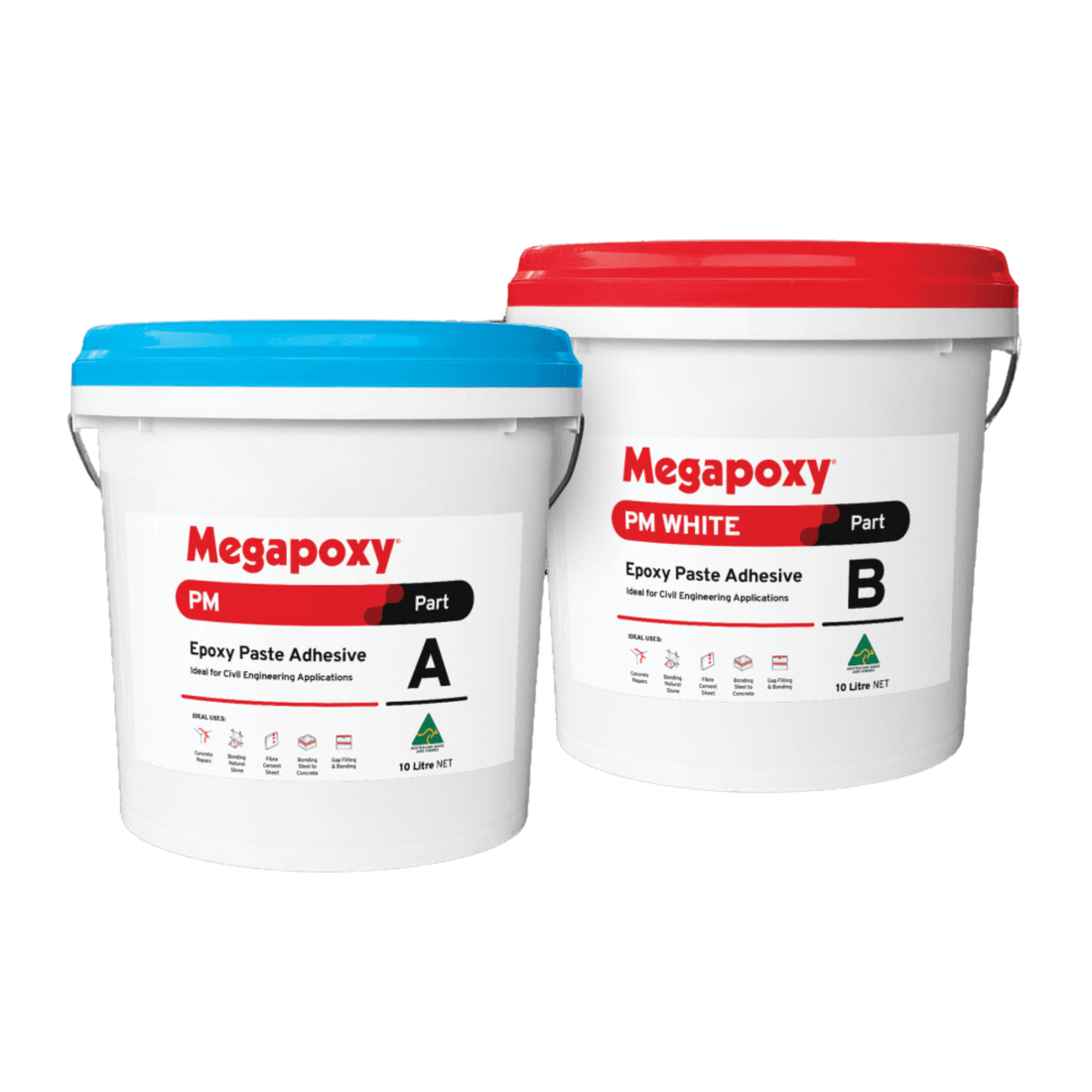
When high-strength bonding or crack sealing demands a rigid, non-sag epoxy, Megapoxy PM delivers a permanent fix. This two-part epoxy paste holds fast, seals tight, and resists harsh conditions. Achieve solid bonds on concrete, metal, and stone, even in cold or damp environments. It’s the reliable choice for detailing crucial joints and preparing cracks for injection.
Why this product exists
Megapoxy PM is a versatile, non-sag epoxy paste designed for applications demanding exceptional strength, chemical resistance, and the ability to cure under challenging conditions. It provides a robust surface seal for concrete cracks prior to injection and serves as a high-strength adhesive for critical waterproofing joint bands. Its easy 1:1 mix ratio and low VOC content make it a practical choice for heavy-duty bonding and filling.
The numbers that matter
- Compressive Strength: 80 MPa — Significantly stronger than typical concrete, allowing it to withstand heavy loads and impacts in repairs or bonding applications.
- Bond Strength: >3 MPa on concrete, 20 MPa on steel — This high adhesion ensures permanent bonds on critical substrates, preventing delamination in structural or high-stress areas.
- Work Time: 45 minutes at 25°C — Provides ample time for mixing, application, and tooling, reducing rework and material waste on larger jobs.
- Cures under adverse conditions — Retains its high performance even when applied in cold or damp environments, extending your working season and reliability.
What it's like to use
Megapoxy PM offers a creamy, non-sag texture, simplifying application on vertical and overhead surfaces without slumping. The 1:1 mix ratio by volume is straightforward, but thorough mixing of Part A and Part B is essential to achieve full strength and prevent discoloration. Surfaces must be clean and prepared: concrete requires mechanical abrasion (or acid etching), while metal needs grit blasting for optimal adhesion. For clean-up, use Megapoxy Thinners immediately after use to clean mixing implements and tools.
Where this product excels
- Crack & joint treatment — detailing and repair: As a pre-injection sealant, Megapoxy PM provides a secure surface cap for concrete cracks, preventing injection resin wastage during critical repair sequences. It also acts as a reliable adhesive for bonding waterproofing joint bands over movement joints, creating a rigid and continuous seal.
- Concrete — membrane covered, tiled: Ideal for surface repair and sealing of cracks in concrete prior to membrane application or tiling. Its superior strength and chemical resistance ensure a durable foundation, even in areas exposed to moisture or chemicals.
- Heavy-duty bonding: Effectively bonds precast concrete articles, metal to concrete or metal, natural stone, bricks, ceramics, and compressed cement sheet. Its high tensile and compressive strengths ensure lasting structural integrity.
- Structural filling and repair: Suitable for flush-filling countersunk screws in fibre cement sheet and repairing concrete elements like pipes, tanks, floors, stairs, and columns, restoring their strength and appearance.
How it fits in a real system
Megapoxy PM frequently appears as a final step in crack and joint treatment sequences. For instance, in concrete joint detailing, it follows the application of injection resins like Megapoxy H and flexible joint sealants such as Adheseal PU25. In this context, Megapoxy PM is typically used to cap the crack or bond joint bands, ensuring a rigid, protective layer over the repair or movement joint. Its role is to provide a final, high-strength seal, particularly when used alongside other epoxy concrete repair products and polyurethane joint sealants.
Choose this when
- When you need to seal the surface of concrete cracks before injecting with low-viscosity resins like Megapoxy HX.
- When the job requires adhering waterproofing joint bands (e.g., XP50) over movement joints for a rigid, secure bond.
- For high-strength structural bonding and filling of concrete, metal, or masonry elements.
- When working in cold or damp conditions, and a reliable cure is paramount.
Don't use this when
- Not for: low-viscosity injection into fine, hairline cracks; this product is a paste, not an injection resin. For injection, use products like Megapoxy HX.
- Not for: flexible movement joints; Megapoxy PM cures rigid. For flexible joints, a polyurethane sealant like Adheseal PU25 is required.
- Not for: standalone priming; it is an adhesive and filler, not a primer for coatings.
- Not for: structural bulk filling without aggregate extension; while strong, for large-volume structural filling, it typically requires extension with appropriate aggregates.
Megapoxy PM versus Megapoxy PF
While both Megapoxy PM and Megapoxy PF are high-strength epoxy pastes for sealing and bonding, their primary difference lies in cure speed and specific application focus. Megapoxy PM offers a longer 45-minute work time, making it ideal for more versatile applications requiring a considered approach to crack capping, joint band adhesion, or general heavy-duty bonding. Megapoxy PF, on the other hand, is formulated for rapid setting, specifically targeting fast crack capping and port bonding in crack injection scenarios where speed is the critical factor for project progression.
Frequently Asked Questions
Will Megapoxy PM stain my white marble or light-coloured stone?
No. Megapoxy PM is specifically formulated to be non-staining. It will not stain or discolour white or light-coloured marble, granite, or ceramics, making it the ideal, risk-free choice for high-value stone installations. This predictable performance protects your work and reputation.
What is the mix ratio and work time for Megapoxy PM?
The mix ratio is a simple and reliable 1 Part A to 1 Part B by volume. Once mixed, you have a practical work time (pot life) of 45 minutes at 25°C, giving you ample time to apply, position, and tool the product without rushing.
Can I use Megapoxy PM for vertical or overhead repairs?
Absolutely. Megapoxy PM is a true non-sag, thixotropic paste. It has a creamy texture that is easy to trowel but will hold its position firmly, making it the perfect solution for vertical surfaces and overhead repairs where slumping or dripping is not an option.
What's the best way to prepare concrete before bonding with Megapoxy PM?
For a first-time-right structural bond, the concrete must be clean, dry, and free of all laitance. The best method is mechanical abrasion such as grit blasting, scabbling, or grinding. This ensures the epoxy is bonding to the sound, structural concrete, not a weak surface layer.
Applications & Benefits
| Application / Use Case | Key Benefit | Primary Trades |
|---|---|---|
| Bonding Natural Stones (White Marble, Granite, Ceramics) | Guaranteed non-staining, non-discolouring, permanent bond. | Stonemasons, Tilers, Builders |
| Structural Concrete Repair (Floors, Stairs, Columns) | Superior-to-concrete strength (80Mpa Compressive) for a permanent fix. | Remedial Contractors, Concreters |
| Vertical & Overhead Bonding / Filling | True non-sag paste with a creamy texture holds its form without slumping. | All Trades |
| Grouting bolts & Bonding Metal to Concrete | High tensile bond strength (20Mpa to Steel) for structural anchoring. | Engineers, Builders, Fabricators |
| Bonding Fibreglass Articles | High-strength, gap-filling adhesive for manufacturing and repairs. | Manufacturers, Marine Fitters |
Applying Megapoxy PM: Enhanced Protocols & Best Practices
-
Step 1: Surface Preparation
Ensure all substrates are prepared according to the Adhesion Profile. Surfaces must be sound, clean, dry, and free of all contaminants to ensure a permanent, structural bond.
Pro Tip: Do not cut corners on preparation. 99% of bond failures are due to a poorly prepared substrate. Mechanical abrasion is always the best choice for concrete and metal. -
Step 2: Measuring & Mixing
This is a critical step for achieving the product's specified strength and non-staining properties. Inaccurate mixing will lead to cure failure.
Measuring
Measure exactly 1 Part A to 1 Part B by volume. Use calibrated mixing containers to ensure accuracy.
Mixing
On a clean board or in a mixing bucket, combine the two parts. Mix thoroughly with a spatula or mechanical mixer (for larger volumes) until the paste is a 100% uniform colour with no streaks visible.
Timing: The work time (pot life) is 45 minutes at 25°C. This time will be shorter in hotter weather and longer in cold weather. Only mix what you can comfortably use within this timeframe.Pro Tip: Always scrape the sides and bottom of the mixing container multiple times during mixing to ensure all material is blended and no unactivated resin or hardener remains. -
Step 3: Application & Curing
Apply the mixed paste to the prepared substrate using a trowel or spatula.
Application
For bonding, apply to one or both surfaces and press together. For repairs or gap filling, trowel the paste into the void, ensuring no air pockets are trapped. The non-sag formula will hold on vertical and overhead surfaces.
Cleaning
Clean all tools, implements, and spills *before* the epoxy cures. Use Megapoxy Thinners for effective cleanup.
Cure Time: Allow a minimum of 24 hours at 25°C for the initial cure. Full structural properties are achieved after several days.
Limitations & Safety
Product Limitations
Professional Use Only: This product is hazardous and intended for professional industrial/trade use. It is not for DIY use.
Sensitiser: Both Part A and Part B may cause an allergic skin reaction (sensitisation). Persons already sensitised may react to very low levels. Avoid all skin contact.
Mix Ratio: The 1:1 mix ratio by volume is critical. Do not alter this ratio, as it will result in a failed cure and loss of all physical properties.
Temperature: Do not apply at substrate or ambient temperatures below 10°C.
Preparation: Do not apply to unprepared, contaminated, or unsound substrates. Bond strength is entirely dependent on substrate quality.
Safety & Handling Requirements
Personal Protective Equipment (PPE)
Always wear safety glasses with side shields (or face shield) and protective gloves (nitrile rubber recommended). Wear protective clothing to prevent skin contact. Ensure an eyewash station is immediately accessible.
Ventilation Requirements
Natural ventilation should be adequate under normal use. Avoid breathing any dust generated during prep or application. Use in a well-ventilated area.
Fire & Handling Precautions
Non-combustible material. Flash Point is >200°C. Store in a cool, dry place out of direct sunlight and away from foodstuffs.
Emergency First Aid
Eyes:
CRITICAL: Part B causes serious, irreversible eye damage (Category 1). IF IN EYES: Rinse cautiously with water for at least 15 minutes. Remove contact lenses, if present and easy to do. Continue rinsing. Immediately call a POISON CENTER (Australia: 13 11 26) or doctor.
Skin:
Causes skin irritation and may cause allergic sensitisation. IF ON SKIN: Immediately remove all contaminated clothing. Wash skin thoroughly with plenty of soap and water. If skin irritation or rash occurs: Get medical advice.
Inhaled:
Remove victim from exposure to fresh air. Keep at rest. Seek medical advice if effects persist.
Swallowed:
Rinse mouth with water. Do NOT induce vomiting. Give a glass of water to drink. Seek medical advice immediately.
Refer to the Safety Data Sheet (SDS) for Part A and Part B before use.
Megapoxy PM Surface Preparation Guide
Concrete
Surface Preparation
Surfaces must be sound, clean, and free from grease and oil. Remove all surface laitance for a successful bond. Mechanical abrasion (grit blasting, grinding, or scabbling) is the best method. If this is not possible, acid etching can be used, but must be thoroughly washed and dried for 24 hours. For maximum adhesion, the concrete should be surface dry.
Primer Requirements
No primer specified
No primer is specified in the technical data. Adhesion is reliant on a clean, sound, and properly prepared substrate.
Metal Surfaces (Steel)
Surface Preparation
Metals must be grit blasted to AS CK 9.4-1964 Class 3 finish for maximum adhesion. If grit blasting is not possible, mechanically abrade the surface to a clean, bright metal finish. Once abraded, flood with an industrial grade degreaser to remove all contaminants. Note: Wire brushing is not entirely satisfactory and provides minimal adhesion only.
Primer Requirements
No primer specified
No primer is specified in the technical data. Bond performance is dependent on achieving a bright, clean, abraded metal finish.
Natural Stone & Ceramics
Surface Preparation
Surfaces must be thoroughly clean, dry, and free from dust, slurry, or processing residues. Ensure the back of the stone or tile is sound and has not been contaminated. Wipe with a clean, dry cloth before application.
Primer Requirements
No primer specified
Ensure surface is clean, dry, and sound.
Download Megapoxy PM Adhesive Documents
| Document | Type | Download |
|---|---|---|
| Technical data sheet | TDS | |
| Safety data sheet - Part 1 | SDS | |
| Safety data sheet - Part 2 | SDS |
- Choosing a selection results in a full page refresh.