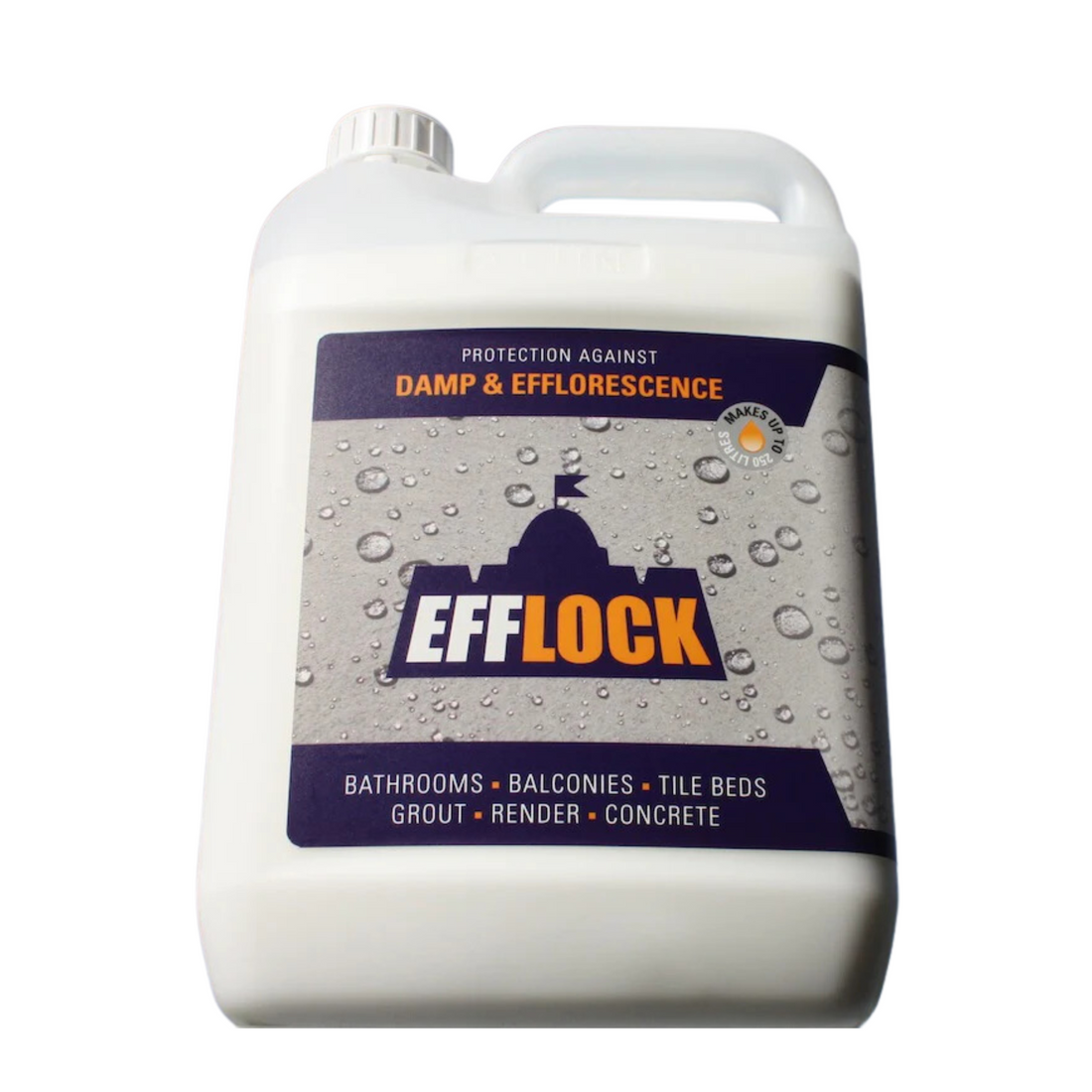
Imagine tiled surfaces, brickwork, and concrete that consistently stay clean, free from unsightly white salt deposits and damp patches. Efflock delivers this by integrating directly into your cement-based mixes, turning them hydrophobic from the moment they are poured or laid. This approach protects against the common causes of surface degradation, ensuring a pristine finish and lasting material health from the inside out.
Why this product exists
Unsightly white salts, dark patches, and general damp can ruin the appearance and integrity of cement-based finishes. Efflock was formulated to stop these problems at their source. It works as a bulk impregnating additive, creating a hydrophobic molecular structure within the pores of screeds, mortars, and concrete.
This internal protection dramatically reduces water absorption without filling pores, allowing the material to breathe while actively repelling contaminants like salts and dirt. This prevents efflorescence, cryptoflorescence, and salt attack. The concentrated, water-based, VOC-free formula also offers environmental benefits and efficient transport.
What it's like to use
Efflock is added directly to the gauging water of cement-based mixes like screeds, tile adhesives, grouts, and mortars. For screeds, it can be added neat, then water to desired consistency, compensating for existing sand moisture. It imparts a lubricating effect, often reducing the need for usual gauging water and improving workability.
Tools clean up with water. Treated materials require protection from rain for 12-24 hours initially, and damp curing for screeds for seven days, mirroring good concrete practice. A water test after 24 hours confirms successful impregnation by showing strong water beading on the surface.
How it fits in a real system
Efflock is typically introduced early in the construction sequence, right at the mixing stage for cement-based materials. In a common ROOFING - CONCRETE ROOF - TO BE TILED system, it integrates into the screed and tile adhesive layers. This positions it after primary waterproofing membranes, such as Everflex WPM or Everflex Aqua-Ban Waterproofing Membrane, providing an internal hydrophobic barrier to the critical bedding and adhesive layers before the final grout and sealant are applied. It reinforces the system from within, ensuring the integrity of the tiled finish against water migration and efflorescence. It is often used in conjunction with a damp concrete primer before the screed or adhesive layers are laid.