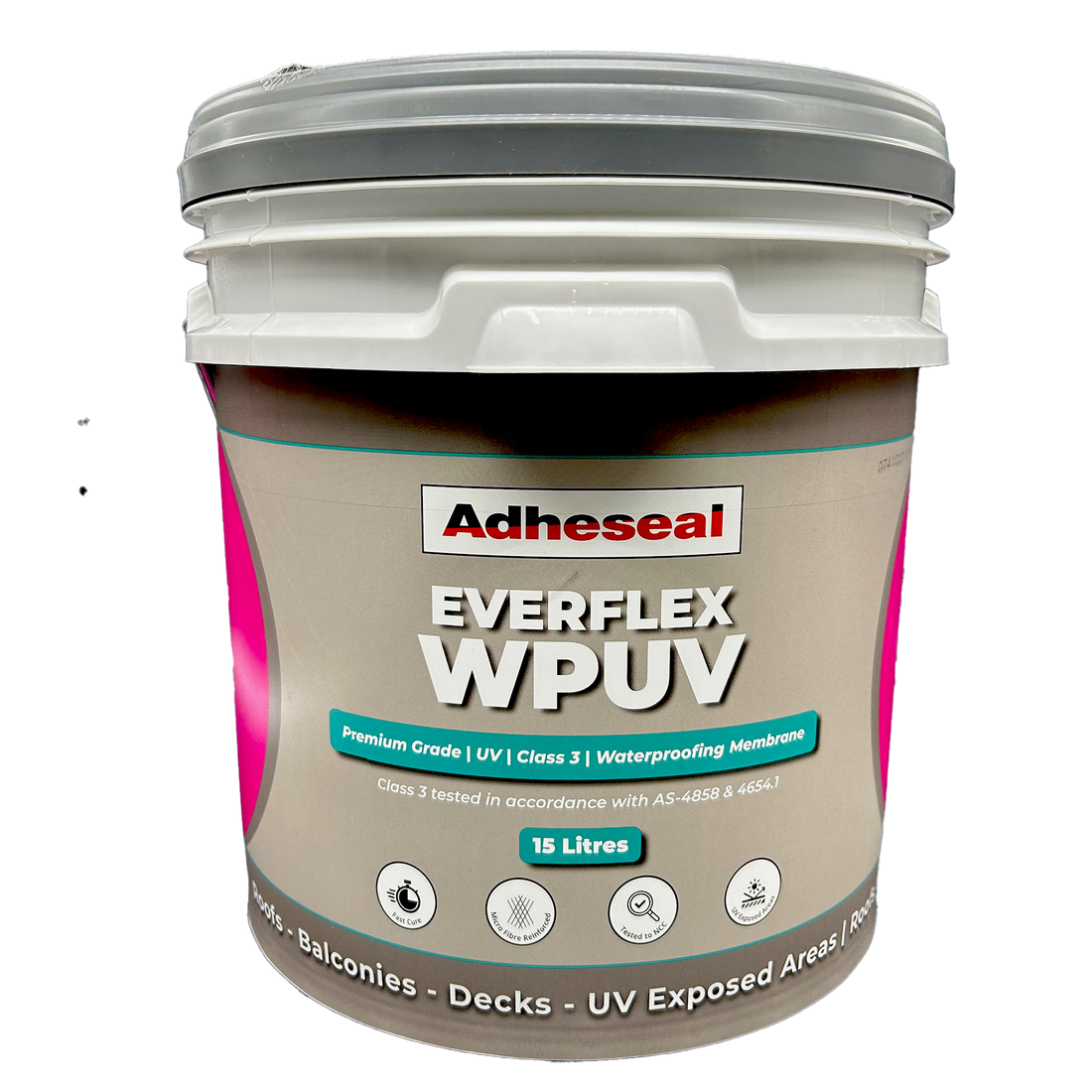
Everflex WPUV is a UV-stable Class III elastomeric waterproof membrane for exposed roofs, balconies, decks and compatible wet-area systems. The micro-fibre-reinforced liquid membrane cures into a seamless barrier designed to tolerate weather exposure and normal building movement.
Compare waterproofing systems: Browse the full waterproofing membrane range to compare liquid, sheet, cementitious and trafficable systems. For this format, also compare our liquid waterproofing membranes. Always match the membrane to substrate, exposure, movement, immersion, traffic and finish requirements.
Best fit in the Everflex range
Choose WPUV for general UV-exposed waterproofing on roofs, balconies, decks and pedestal systems. If the job specifically calls for a higher-viscosity, high-build application profile, compare Everflex HVUV. For bathrooms and tiled areas where the membrane will be covered, Aqua-Ban and WPM are the more targeted under-tile options.
How it works
Everflex WPUV is a single-component, water-based copolymer that cures to form a fully bonded, elastomeric barrier. It is micro-fibre reinforced to improve film strength and tensile durability. Achieving Class III high elasticity allows the cured membrane to accommodate structural movement in joint, wall, and floor transitions without rupturing. It also incorporates biological inhibitors to prevent the growth of mould and mildew in damp internal or external environments.
Numbers that matter
-
Class III: High elasticity classification under AS-4858:2004 and AS4654.1:2012, allowing maximum joint and substrate movement accommodation.
-
1.0mm DFT: The minimum dry film thickness required for internal installations, achieved in at least two coats.
-
1.3mm DFT: The minimum dry film thickness required for external installations to withstand environmental exposure.
-
2.2g/m²/24h: Moisture vapour permeability rating, controlling water transmission through the cured film.
-
<2g/L VOC: Low volatile organic compound content, meeting Green Star environmental criteria for indoor air quality.
Where to use it
Everflex WPUV is suitable for both internal and external substrates, including:
- Exposed roofs and under-pedestal deck systems.
- Patios, terraces, balconies, and decks.
- Wet areas, shower recesses, laundries, toilets, and kitchens.
- Under-tile installations using solvent-free tile adhesives such as RLA or Gripset C-Lite, C-Mastic, Unigrip, and Mastic.
Acceptable substrates
- Concrete cured for at least 28 days.
- Masonry and cement render cured for at least 4 days.
- 3:1 sand cement screeds or Gripset C-Bed engineered screeds.
- Cement sheeting, underlay, external weatherboard, and blue board.
- Pre-cast concrete once release agents are completely removed.
- Wet area plasterboard and Villaboard.
- Timber flooring including Type A structural plywood (PAA JAS-ANZ).
- Brickwork and Hebel aggregate blocks.
Installation limits and preparation
All surfaces must be structurally sound, dry, clean, and free of oils, grease, curing compounds, and loose materials. Ground-surface protrusions must be removed to prevent thin spots in the membrane. Non-structural cracks and holes must be filled prior to application. WPUV cannot span open gaps.
For internal priming, apply Everflex WBP. For external balconies and roof decks, prime with Everflex VBS. Apply Everflex WPUV within 2 to 24 hours of the primer becoming touch-dry.
Thoroughly mix Everflex WPUV before application. Apply the first coat with a brush or roller at approximately 0.75mm wet film thickness (WFT). Apply the second coat at a right angle to the first at 0.75mm WFT. Always verify wet film thickness during application with a WFT gauge to ensure specified dry film thickness (DFT) targets are met. Allow 48 hours curing time at 25°C and 50% relative humidity before tiling.
System detailing
-
Floor wastes and puddle flanges: Rebate into the floor to ensure positive drainage. Seal gaps and perimeters with Adheseal Hi-Flex MS sealant.
-
Waterstops and plastic corner angles: Seal and secure using Hi-Flex MS sealant.
-
Gaps, joints, and internal corners: Apply a fillet of Hi-Flex MS sealant or a suitable bond breaker in accordance with Australian Standards. For dynamic cracks, expansion joints, and control joints, use Adheseal Elastoband or Butyl Tape systems. Polyester reinforcing fabric can be embedded into the first membrane coat at joints and corners if required.
-
Additional protection: Apply LS slip-resistant UV protective coating where further mechanical and UV wear protection is required.
Limitations
- Do not apply if ambient or substrate temperatures are below 10°C or above 35°C.
- Do not apply on damp, wet, or contaminated substrates, or if rain is imminent.
- Not suitable for areas subject to negative hydrostatic pressure or rising damp.
- Not suitable for foot traffic greater than regular maintenance access.
- Light Grey has a Solar Reflectance Index (SRI) of approximately 0.32. Adding up to 75ml of black Glycol tint will alter the cured colour but will change the SRI rating.