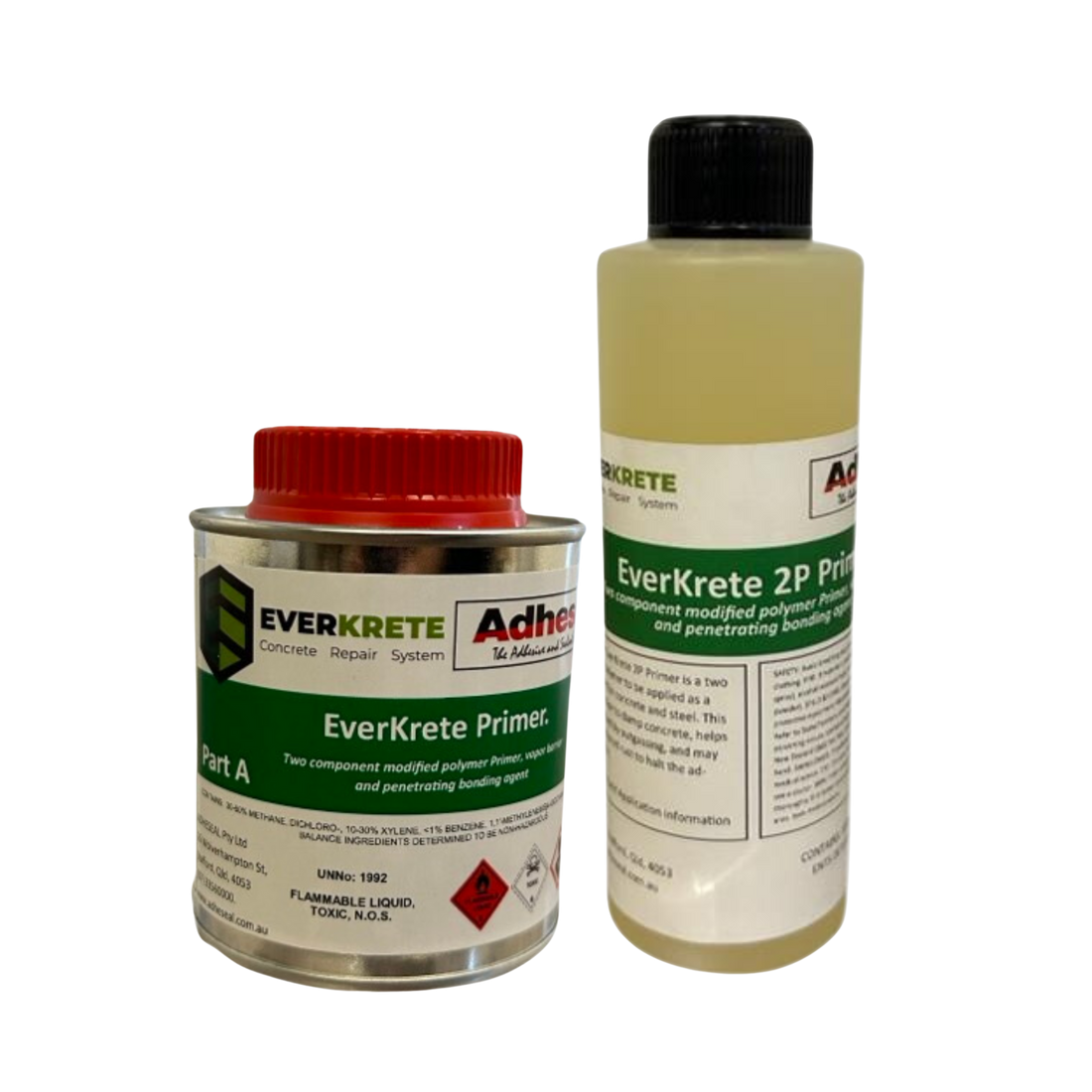
For structural repairs using EverKrete concrete repair mortar, EverKrete Primer serves as the essential penetrating bond agent and vapour barrier on concrete, steel, and masonry substrates. This single-component polyurethane primer penetrates the surface to promote adhesion, helps prevent pinholing caused by substrate outgassing, and can be applied over tightly adhered rust on steel reinforcement to halt corrosion advancement.
Adhesion and vapour protection
EverKrete Primer is a low-viscosity, single-part polyurethane liquid that cures exothermically to form a tough bonding layer. It achieves excellent adhesion to both porous and non-porous substrates, including pre-cast concrete, 3:1 sand cement screeds, C-Bed, Hebel, and burnished concrete. By sealing the pores of cementitious substrates, it stops escaping air from creating pinholes in the wet repair mortar. It also acts as a vapour barrier with a standard moisture vapour transmission rating of 0.032 perms (ASTM E 96-80) to protect the repair zone from moisture movement.
Numbers that matter
-
5 to 8m² per litre consumption: Coverage depends on substrate porosity, providing an estimating floor for material calculations on porous masonry or dense concrete.
-
1 to 2 hours tack-free time: Fast-drying formulation at 25°C and 60% relative humidity, establishing a reliable window to commence mortar installation.
-
30 to 60 cps viscosity: Low viscosity allows the liquid to penetrate deeply into the capillaries of concrete and aggregate blocks.
-
0.032 perms (ASTM E 96-80) MVT: Low moisture vapour transmission rate provides a barrier against moisture migration behind the repair mortar.
-
Same-day overcoating: EverKrete mortar must be applied on the same day while the primer remains clean and tacky; do not leave the primer exposed for extended periods.
Where to use it
-
Concrete: Must be cured for at least 28 days prior to primer application.
-
3:1 sand cement screed or C-Bed: Provides a stable bonding foundation for cementitious screeds.
-
Masonry and render: Suitable for application after a minimum curing period of 4 days.
-
Pre-cast concrete: Apply once all release agents have been completely removed or dissipated.
-
Exposed reinforcement steel: Can be applied directly over tightly adhered rust after loose rust is mechanically removed.
-
Non-porous substrates: Suitable for burnished concrete and ceramic tiles after mechanical abrading or diamond grinding.
Application and subfloor preparation
All substrates must be structurally sound, dry, clean, and free of dust, laitance, grease, curing compounds, and form release agents. For steel and Reo bar, remove loose rust by blasting or mechanical means. If mechanical preparation is required on floors, use dry diamond grinding to establish an open, porous surface. Do not use solvents or acid etching.
To determine porosity, perform a water drop test: dispense a puddle of water the size of a $1 coin onto the surface. If the water absorbs in less than two minutes, the substrate is porous. If the puddle remains, the substrate is non-porous and requires mechanical abrading.
Apply the primer to porous surfaces using a brush or roller, working it thoroughly into the substrate to leave a smooth, thin coating without ridges or puddles. For application in temperatures below 5°C, use a neat solution of EverKrete 102 resin and EverKrete Accelerator instead of this primer.
Limitations
-
Temperature limits: Do not apply when substrate or ambient temperatures are below 5°C or above 35°C.
-
Substrate moisture: Do not apply on damp, wet, or contaminated substrates, or if rain is imminent.
-
UV exposure: Limited UV resistance; the primer is not designed for long-term exposure and must be overcoated.
-
Humidity sensitivity: The polyurethane chemistry is highly sensitive to humidity. Store between 15°C and 25°C in sealed cans, and reseal with nitrogen after opening to prevent skinning, clouding, or discolouration.