





14
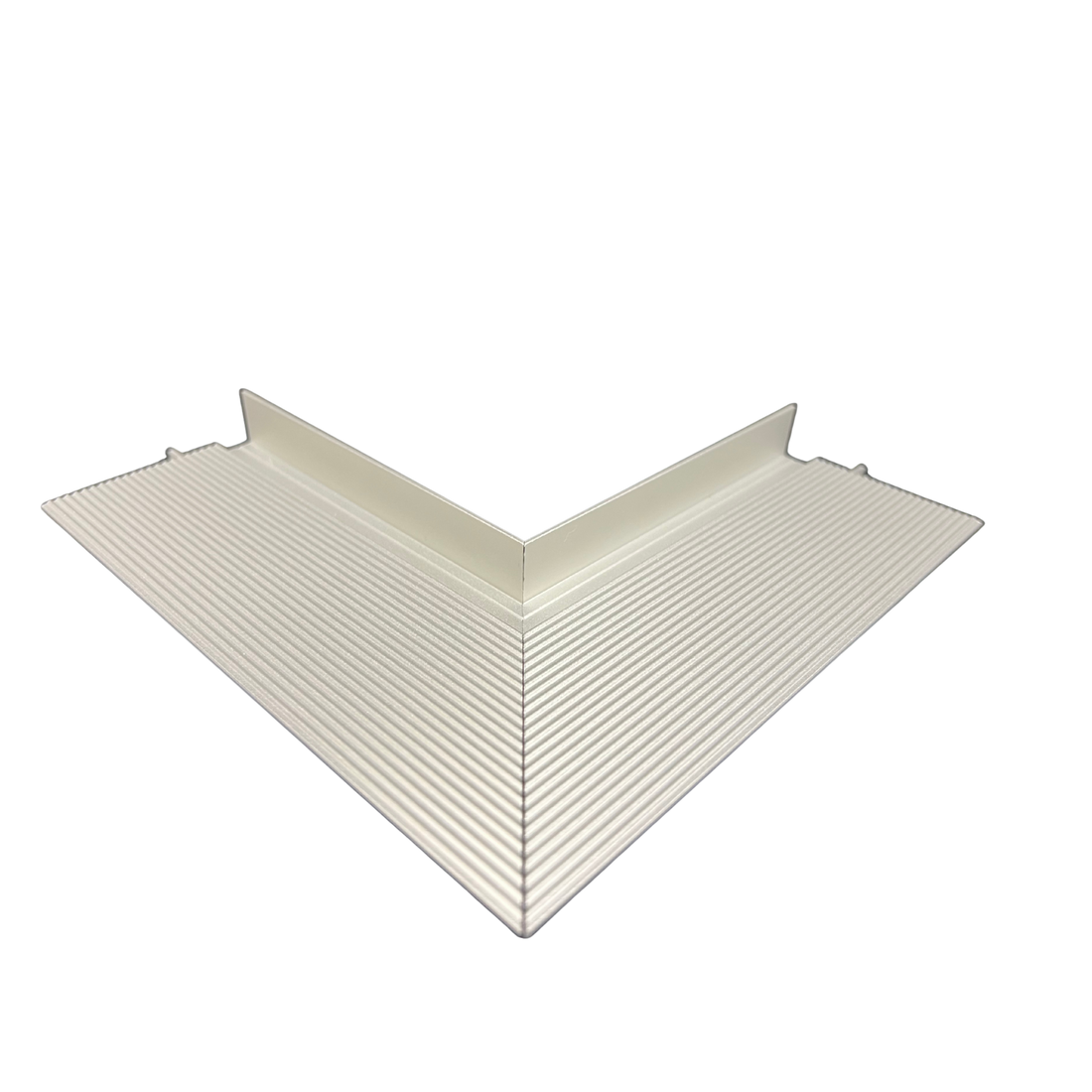


Why Choose Balcony Drip Angle 90° Internal Corner
Use Balcony Drip Angle 90° Internal Corner for critical junctions where a factory-precise 90° internal corner is required to stop water tracking and provide a rigid substrate for membrane termination. This anodised aluminium component delivers a definitive mechanical capillary break at structural reveals, reducing reliance on brittle site-bent profiles and field mitering.
Balcony Drip Angle 90° Internal Corner Common Uses
Use this component where a balcony slab meets a vertical wall and a non-negotiable internal corner geometry is required to protect waterproofing from abrasion and ponding.
- Junctions where the balcony plane intersects a 90° internal wall reveal.
- Termination points for liquid-applied or sheet membranes that require a rigid, non-flexing substrate.
- Locations that demand a pre-fabricated drip path to prevent capillary rise behind the slab.
Where Balcony Drip Angle 90° Internal Corner Performs Best
Performs reliably on aluminium or treated steel substrates in sheltered-to-moderate weathering environments where the geometry is strictly a 90° internal corner and the surrounding assembly can be properly sealed.
Coverage, Skin Time & Cure
Yield and coverage are defined by the 155mm x 155mm pre-fabricated profile, enabling a consistent overlap at the reveal. Skin time and cure depend on the selected membrane and ambient conditions; follow the membrane manufacturer’s instructions for tooling off and trafficability.
- Leg length: 155 mm per side.
- Profile designed for a precision fit at structural junctions.
- Anodised finish requires compatible primers to achieve reliable membrane bond.
Surface Prep & Application
Prepare the substrate to maximise bond durability and long-term moisture protection.
- Clean the joint area to remove dust, oils, and loose particles.
- Scuff or prime the anodised aluminium to ensure compatible adhesion with the membrane system.
- Position the corner with mechanical fixings as designed, avoiding reliance on friction fit.
- Apply a compatible sealant at the interface between the corner and adjacent surfaces to complete the capillary break.
Best Practices for Using Balcony Drip Angle 90° Internal Corner
Integrate the corner within a sequenced waterproofing strategy that accounts for slab movement, drainage, and membrane compatibility.
- Use a compatible primer on the anodised surface before membrane application.
- Employ mechanical fixings plus a continuous sealant bead; do not rely on friction fit alone.
- Verify leg alignment with the adjoining drip angle sections to maintain consistent profile height.
- Avoid direct contact between stainless steel fixings and the aluminium in wet zones to limit galvanic risk.
Handling & Storage
Handle and store the component to protect the anodised surface and dimensional integrity.
- Wear appropriate PPE during installation; ensure ventilation when using site-applied sealants.
- Store in a dry, shaded environment to prevent surface contamination.
- Transport upright or with edge protection to avoid distortion of the 90° geometry.
- Dispose of offcuts in accordance with local regulations; aluminium scrap may be recyclable.
- Choosing a selection results in a full page refresh.