
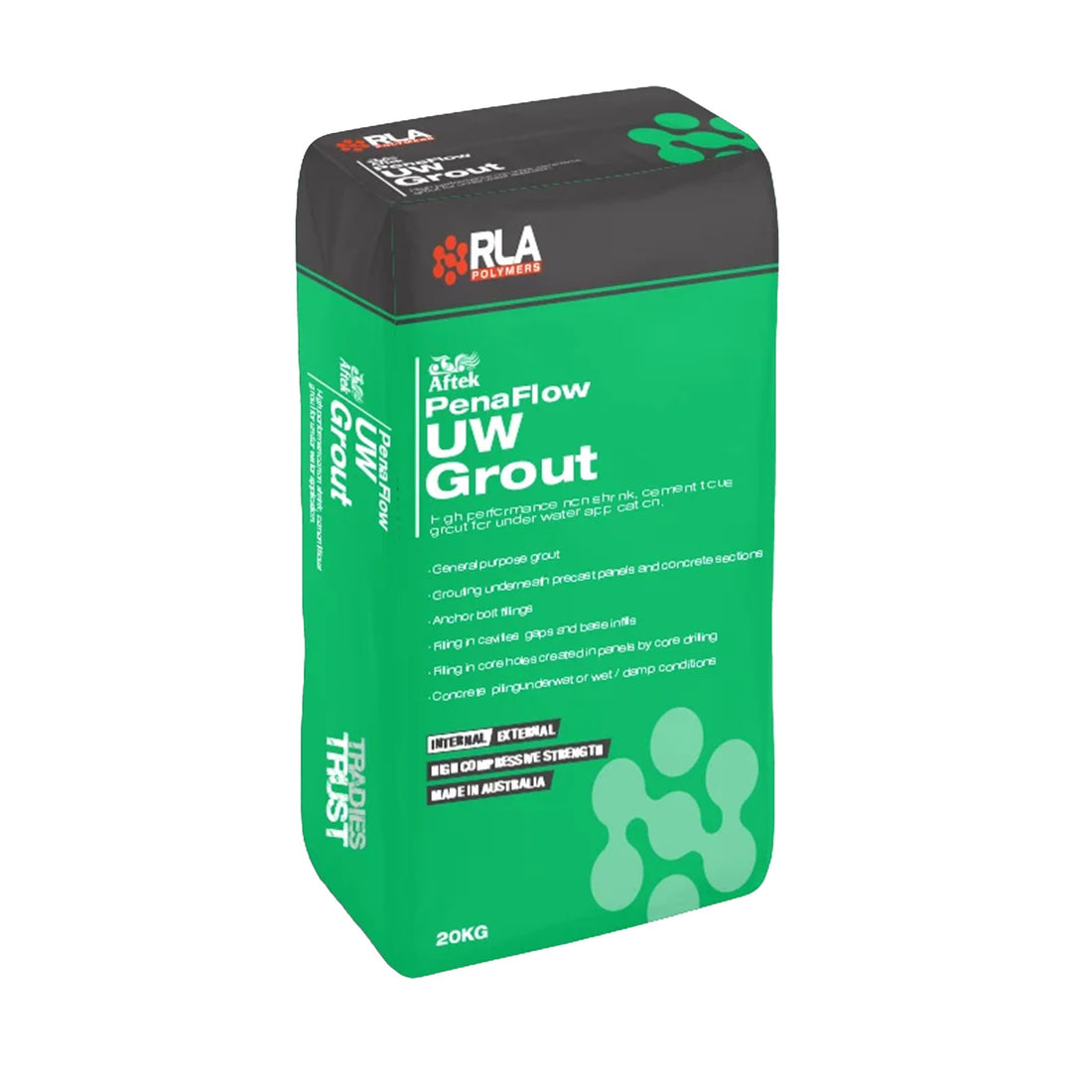
RLA Penaflow UW Grout delivers certainty in the most demanding environment: underwater. Designed specifically for submerged and tidal zone applications, this high-performance Class A cementitious grout resists "wash-out," ensuring your material stays exactly where you place it without segregation. It solves the critical challenge of maintaining structural integrity in wet conditions, protecting your project from costly failures and environmental contamination.
Engineered with a blend of Portland cement, graded aggregates, and specialised additives, it provides a positive gaseous expansion (1-2%) while in the plastic state to completely eliminate shrinkage and settlement. Whether you are reinstating wharf columns or filling anchor bolts, RLA Penaflow UW Grout achieves exceptional compressive strength—exceeding 60MPa at 28 days. It gives you predictable performance and structural confidence, allowing you to sign off on critical marine works with zero doubt.
Potential Outcome: The grout will segregate and bleed, destroying its strength and wash-out resistance.
Adheseal Best Practice: Stick strictly to the 3.6–4.0L limit per 20kg bag for flowable mix. If you need more flow, check your pump, don't water down the product.
Potential Outcome: Mechanical vibration causes segregation and separation of the aggregate.
Adheseal Best Practice: Rely on the grout's natural head pressure and gravity flow. Use a header box to maintain continuous flow without vibration.
Reinstating structural integrity on tidal columns where keeping the area dry is impossible. You need a material that won't wash away with the tide or current.
Use RLA Penaflow UW Grout mixed to a flowable consistency. Pump from the bottom up using a tremie pipe method. The grout displaces the water without mixing with it, creating a dense, high-strength repair. Success means a monolithic repair that passes inspection immediately.
Ensure formwork is watertight. Use foam rubber strips or a sealant at the base to prevent grout leaks during the pour.
Filling gaps under precast panels or piles submerged in water. Any segregation creates voids and compromises the load-bearing capacity of the structure.
Set up a header box to maintain positive pressure. Pour RLA Penaflow UW continuously from one side only to prevent air entrapment. The gaseous expansion ensures the grout locks tightly against the underside of the panel. Success means a verified, solid load path with no costly callbacks.
Do not exceed 150mm thickness in a single application. For larger voids, consult the engineer for aggregate extension guidelines.
Yes, it is tested to AS 1012.9 and AS 2073, achieving over 60MPa after 28 days. This high compressive strength ensures it meets the rigorous demands of structural marine applications and underwater piling, giving you verified performance proof for compliance sign-off.
Use strictly between 3.6 and 4.0 litres of clean water per 20kg bag for a flowable mix. Accurate water measurement is critical; adding extra water to improve flow will cause segregation, bleeding, and strength loss, leading to potential failure and rework.
Absolutely, RLA Penaflow UW Grout is specifically engineered for underwater piling and tidal zone applications. It contains anti-washout additives that keep the mix cohesive when submerged, ensuring the material stays in place and cures to full strength without washing away.
At 20°C, the initial set time ranges from 1.5 hours (Dry Pack) to 4.5 hours (Flowable). These times allow sufficient window for placement while ensuring the product begins to gain strength reasonably quickly to secure the installation.
| Application / Use Case | Key Benefit | Primary Trades |
|---|---|---|
| Underwater Concrete Piling | Resists washout, ensuring full structural strength | Piling Contractors, Marine Engineers |
| Wharf Column Reinstatement | High density displaces water for void-free repair | Remedial Contractors, Builders |
| Precast Panel Grouting (Submerged) | Positive expansion eliminates shrinkage gaps | Precast Installers, Builders |
| Anchor Bolt Filling | High flow fills intricate cavities completely | Structural Steel Installers |
| Dam Wall Reinstatement | High compressive strength (>60 MPa) | Civil Contractors |
Construct leakproof, watertight formwork. Use foam rubber strips or silicone sealant at joints to prevent grout loss.
Ensure formwork allows for a grout head (header box) above the underside of the base plate to maintain gravity flow.
Mechanical mixing is mandatory. Use a high shear mixer or forced action mixer. Do not mix by hand.
Dry Pack: 2.7 - 2.9 Litres
Trowellable: 3.0 - 3.4 Litres
Flowable: 3.6 - 4.0 Litres
Place continuously to avoid air entrapment. Do not vibrate.
Use a positive displacement pump. Pump from the bottom upwards to displace water and prevent air pockets.
Pour from one side only using a header box. Maintain the grout head at all times to ensure continuous flow.
Wear protective gloves, safety glasses, and overalls. Use a suitable dust mask (P1 or P2) to prevent inhalation of cement dust.
Use in well-ventilated areas. Avoid generating dust during mixing.
Substrates must be clean, sound, and free from dust, oil, grease, curing compounds, or marine growth. For tidal zone applications, presoak the prepared area with water for 4 hours prior to grouting to reduce substrate porosity.
Ensure the substrate is saturated surface dry (SSD) if not underwater. Bolt holes and anchor points must be clean.