
Download Product Data
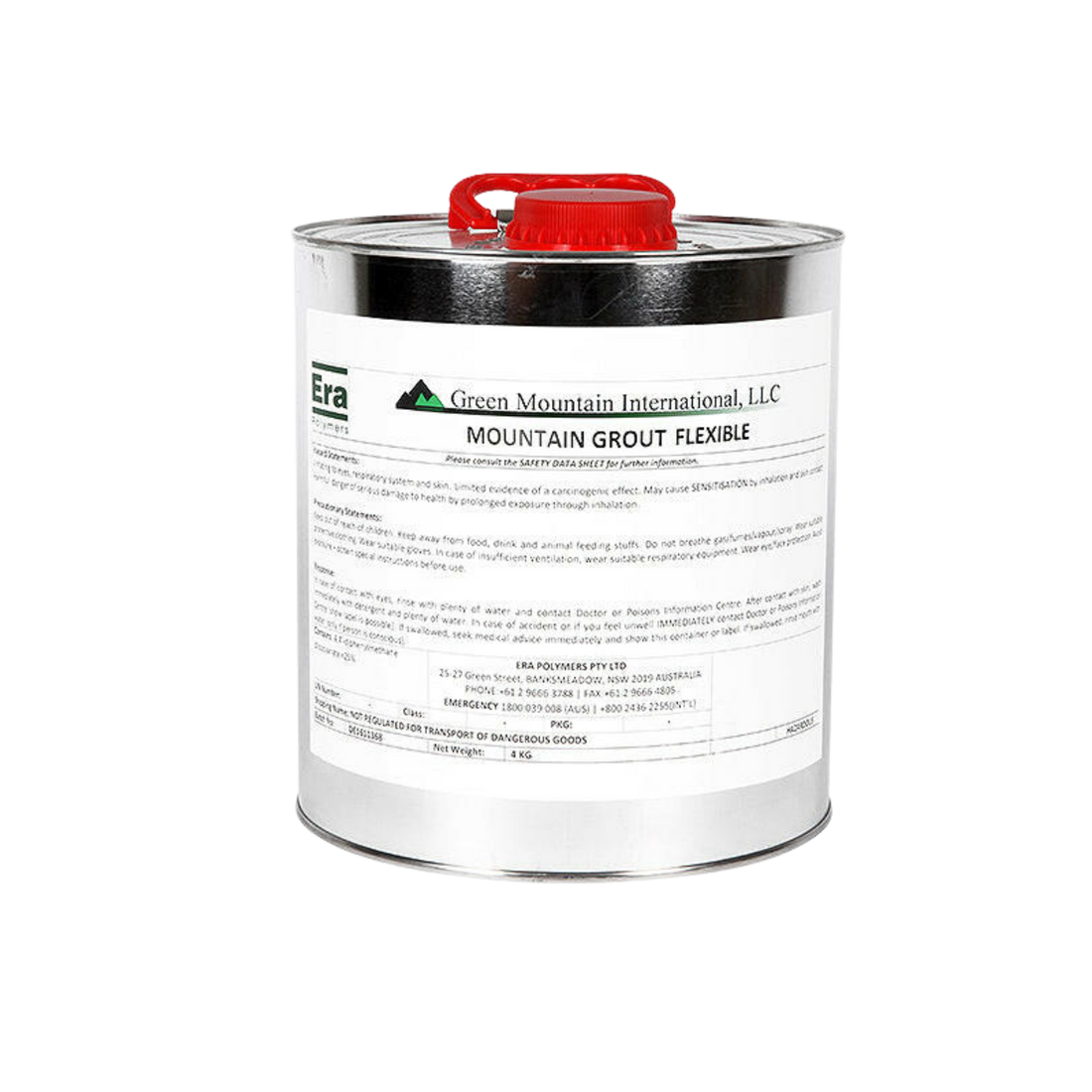
For sealing leaking cracks and failed joints in concrete structures under wet/dry cycles, Mountain Grout Flexible provides a hydrophobic barrier that resists shrinkage. When injected into storm water systems, tunnels, manholes, or concrete dams, this closed-cell polyurethane foam reacts with moisture to form an inert, permanent seal that accommodates structural movement without losing adhesion.
How it works
Mountain Grout Flexible is a low-viscosity, hydrophobic polyurethane system consisting of an amber base resin and Accelerator B. Unlike hydrophilic grouts that require constant moisture to maintain their volume, this hydrophobic formulation reacts with minimal water to form a stable closed-cell foam. Because the cured grout does not rely on retained water, it will not shrink or lose its seal when water tables drop or joints dry out. The system pumps as a single component after mixing the base resin and accelerator, allowing the installer to adjust the reaction profile on-site to match the water flow and temperature of the concrete substrate.
Where to use it
- Concrete dams and earthen dams
- Waste treatment plants and water-related facilities
- Storm water systems and manhole facilities
- Tunnels and underground vaults
- Elevator pits and parking garages
Numbers that matter
- 44% elongation (ASTM D-638): High flexibility to absorb joint expansion and contraction in concrete structures without tearing or delaminating.
- Up to 30x expansion: Expands up to 30 times its initial liquid volume to fill deep voids and wide cracks behind leaking concrete walls.
- <1% water absorption (ASTM D-2842): Highly impermeable closed-cell structure prevents water migration through the cured seal.
- 500 cps base viscosity (ASTM D-1638): Low viscosity allows deep penetration into fine fractures and tight concrete joints before reaction begins.
- 15-second to 50-second initiation windows: Reaction speeds are controlled by the dosage of Accelerator B at 25ºC, letting installers match the foam rise to the water pressure.
Controlling reaction times
The reaction profile must be adjusted prior to pumping by mixing Accelerator B into the base resin. The speed of the expansion is determined by the accelerator dosage, substrate temperature, and the amount of moisture encountered. At 25ºC, the reaction times are:
- At 1.25% dosage (1/2 pint per 5 gallons): Expansion starts in approximately 50 seconds and completes in approximately 4 minutes after encountering water.
- At 2.5% dosage (1 pint per 5 gallons): Expansion starts in approximately 15 seconds and completes in approximately 65 seconds after encountering water.
Frequently asked questions
How do I control grout gel and rise times?
Adjusting Accelerator “B” directly controls reaction speed. At 25°C, 1.25% Accelerator “B” starts expansion at 50 seconds, completing in 4 minutes. Increasing to 2.5% Accelerator “B” accelerates this to 15 seconds start and 65 seconds completion.
Does Mountain Grout Flexible require water to react?
Yes, the hydrophobic formulation requires water contact to foam and expand. For very dry crack sections, pre-wetting ensures a consistent reaction, but avoid flooding that could wash out the resin.
Is this grout suitable for long-term wet/dry cycling?
Yes, the cured grout forms a stable, closed-cell, hydrophobic foam. This material is designed to retain its physical form and resist shrinkage under prolonged wet/dry conditions, ensuring durable water cut-off.
What are the key cured properties of the foam?
The cured foam has a typical density of 64 kg/m³ and an elongation of 44%, allowing it to handle crack movement. Water absorption is less than 1%, and the material is inert and non-toxic once cured.
Applications and benefits
| Application | Key benefit | Primary trades |
|---|---|---|
| Seal leaking cracks in concrete structures | Forms a hydrophobic, closed-cell foam that maintains a seal through wet/dry cycles. | Remedial waterproofers, civil contractors |
| Stop infiltration at manholes and vaults | Expands up to 30 times to chase water paths, creating a robust grout curtain. | Asset maintenance, wastewater utilities |
| Restore watertightness at concrete construction or cold joints | Controlled reaction times ensure the resin foams in situ before washout can occur. | Engineers/specifiers, remedial waterproofers |
| Leak cut-off in tunnels, culverts, and dams | Single-component pumping capability accelerates mobilisation and increases on-site throughput. | Civil contractors, infrastructure maintenance |
| Waterproofing elevator pits and parking structures | Provides a durable, inert, non-toxic seal for long-term service without degradation. | Remedial waterproofers, facility maintenance |
Applying Mountain Grout Flexible: Enhanced Protocols & Best Practices
-
Assessment & Preparation
Identify leak sources, map water paths, and select port locations to progressively intercept flow. Clean and seal around ports to contain resin during rise.
Leak Mapping
Start at the lowest/outlet point and work upstream. Mark damp areas for pre-wetting if required.
Port Strategy
Use close spacing in thick sections and where flow paths branch. Prepare for staged injections.
Timing: Allow sufficient setup to keep injection continuous once started.Pro Tip: Pre-wet very dry sections to support consistent reaction without risking washout. -
Resin Setup & Accelerator Dosing
Dose Accelerator “B” into the base resin before pumping to suit site temperature and leak rate.
Standard Seepage
~1.25% “B” for start ~50 s and completion ~4 min at 25 °C, promoting deeper penetration before rise.
High-Flow Leak
~2.5% “B” for start ~15 s and completion ~65 s at 25 °C to minimise washout risk.
Timing: Reaction accelerates at higher temperatures and slows when cooler; adjust dosage accordingly.Pro Tip: Mix thoroughly and keep records of dosage vs ambient temperature for repeatable results. -
Injection & Monitoring
Pump as a single component. Begin from the lowest/most downstream port and progress sequentially to upstream ports.
Controlled Pressure
Use modest pressures to favour in-situ foaming and prevent resin bypass.
Verification
Watch for backflow or moisture changes at adjacent ports; proceed once the path is saturated.
Timing: Maintain continuous pumping during the gel window for each port.Pro Tip: If washout is observed, increase “B” dosage and re-stage from downstream. -
Post-Injection QA
Observe leak reduction under the prevailing head. Remove ports and make good once performance is confirmed.
Functional Check
Confirm no visible inflow; monitor for rewetting after pressure equalises.
Documentation
Record port sequence, dosages, and outcomes for asset records.
Timing: Allow foam to fully develop per selected reaction profile before removal.Pro Tip: Re-check after rainfall or system surges to verify long-term stability.
Product limitations
- Not for: Applications without water present; the resin requires water contact to react and expand. Very dry cracks may need pre-wetting.
- Not for: Surface-applied cosmetic crack filling; this product is designed specifically for injection and subsurface sealing.
- Note: Reaction times will vary with ambient temperature and moisture levels; adjust Accelerator “B” dosage accordingly to suit site conditions.
Safety and handling
Personal protective equipment
Wear chemical-resistant gloves, eye protection, and suitable workwear to avoid skin and eye contact.
Ventilation
Use in well-ventilated areas. For enclosed spaces, ensure adequate airflow and comply with confined-space protocols if applicable.
First aid
- Eyes: Rinse cautiously with water for several minutes. Remove contact lenses if present and easy to do, then continue rinsing.
- Skin: Wash with soap and water. Remove contaminated clothing and launder before reuse.
- Inhaled: Move to fresh air and keep at rest in a position comfortable for breathing.
- Swallowed: Rinse mouth. Do not induce vomiting. Seek medical attention.
Substrate guide
Proper surface preparation and moisture management are critical for effective leak sealing.
Concrete – Active leaking crack
Surface prep: Identify the water path and install injection ports to intercept the flow. Clean surfaces around ports for proper sealing. Pre-wet adjacent dry areas to ensure water contact without causing washout.
Primer: Not required. Focus on ensuring water presence and correct port placement for effective injection.
Concrete – Damp or seeping crack
Surface prep: Map the seepage area, remove loose fines, and ensure a consistent moisture film is present. Consider a moderate Accelerator “B” dosage to allow deeper penetration before foaming.
Primer: Not required. Maintain steady injection pressure and monitor for backflow at adjacent ports to ensure full crack saturation.
Concrete – Cold or construction joint
Surface prep: Port along the joint line to intercept leak planes. Remove loose laitance at port faces and seal the surface to contain the resin during expansion.
Primer: Not required. Select Accelerator “B” dosage based on the observed inflow rate and the ambient temperature.
Manholes and pipe penetrations in concrete
Surface prep: Expose annular paths, install ports to encircle the penetration, and ensure moisture contact along the leak path. Clean the surface for sealant adhesion around port collars.
Primer: Not required. Stage injections to build a complete grout curtain around the penetration, ensuring full encapsulation.
Mountain Grout Flexible Physical Properties
| Property | Value |
|---|---|
| Base Chemistry | Hydrophobic polyurethane |
| Curing System | Single-component |
| Colour | Amber (base resin), clear (Accelerator B) |
| Density | 64 kg/m³ |
| Viscosity Base Resin | 500 mPa·s |
| Viscosity Accelerator B | 25 mPa·s |
| Flash Point Base Resin | >121°C |
| Flash Point Accelerator B | 107°C |
| Tensile Strength | 0.20 MPa |
| Shear Strength | 0.12 MPa |
| Elongation | 44% |
| Expansion Ratio | Up to 30x |
| Cure Rate | Start ~15 s, complete ~65 s (with 2.5% Accelerator B at 25°C) |
| Water Absorption | <1% |
| Substrate Compatibility | Cracked/damp concrete, construction joints, manholes, tunnels, dams, vaults, elevator pits, parking structures |
| VOC Content | No VOCs (100% solids) |
| Standards | ASTM D-1638 (foam density), ASTM D-1475 (specific gravity), ASTM D-92 (flash), ASTM D-1622 (density), ASTM D-638 (tensile/elongation), ASTM C-273 (shear), ASTM D-2842 (water absorption) |
