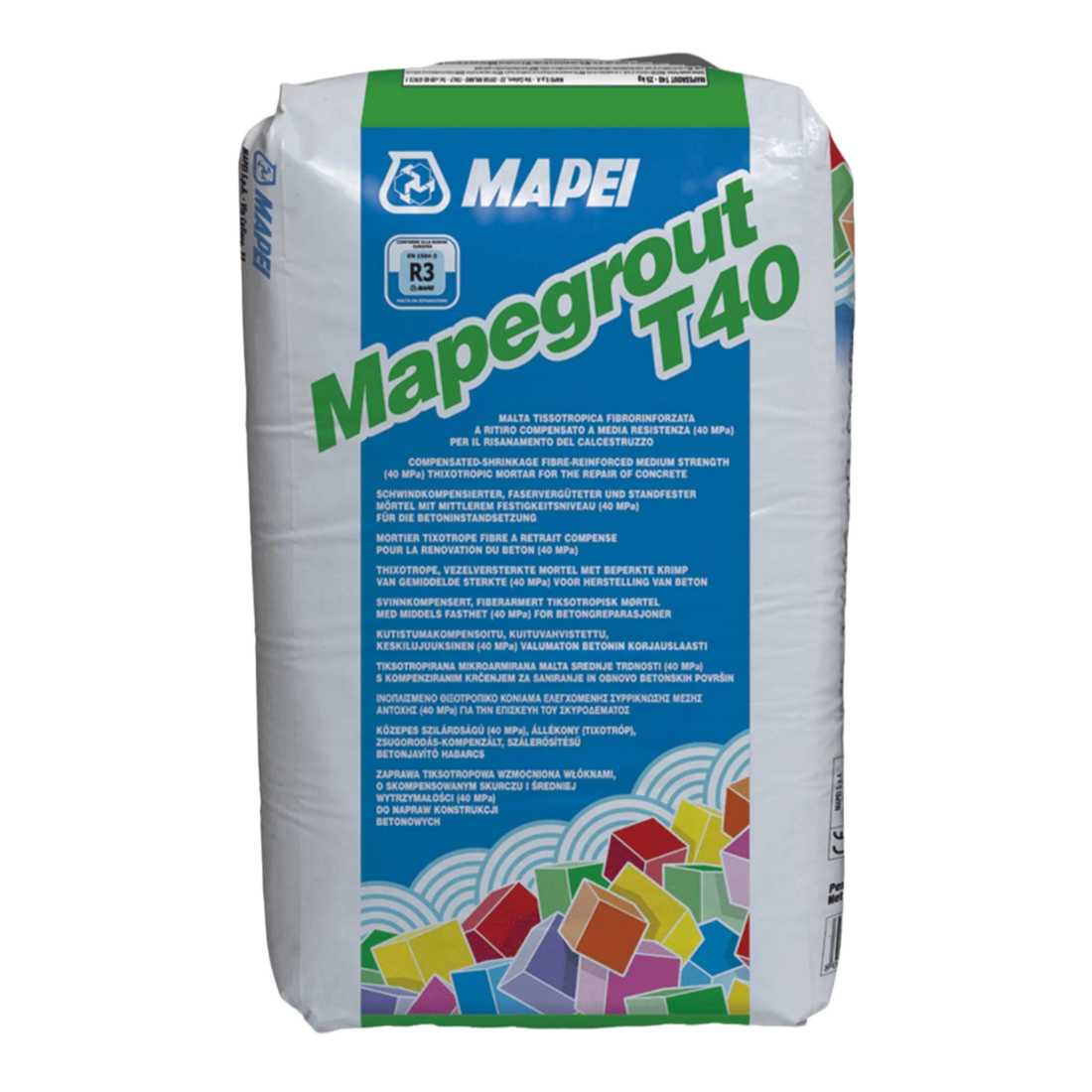
For repairing degraded vertical or horizontal concrete surfaces, Mapegrout T40 Mortar provides a medium-strength, thixotropic system that can be applied to vertical faces and ceilings without slumping or requiring formwork. It is formulated to match the physical characteristics of medium-quality concrete, preventing differential movement cracks on pillars, beams, balconies, tunnels, and canal linings.
How it works
Mapegrout T40 Mortar is a cement-based, fibre-reinforced mortar that complies with EN 1504-3 as a Class R3 structural mortar. When mixed with water, its thixotropic consistency allows high-build application up to 35 mm per layer without falling away from the substrate. It features a shrinkage-compensated formula that counteracts plastic shrinkage during the initial curing phase, provided the substrate is rough and correctly reinforced.
To ensure the expansion properties develop correctly when curing in open-air conditions on site, the mortar can be mixed with 0.25% Mapecure SRA. This additive acts as an internal curing agent to slow water evaporation, reducing dry shrinkage by 20% to 50% and lowering the risk of surface cracking. Once cured, the mortar is waterproof and shares a similar modulus of elasticity, thermal expansion, and permeability to existing medium-grade concrete substrates.
Numbers that matter
-
40 MPa compressive strength (after 28 days to EN 12190): Achieves Class R3 structural performance, with >8 MPa after 1 day and >30 MPa after 7 days to match medium-strength concrete loads.
-
30 to 35 mm thickness per layer: The maximum application thickness achievable in a single pass on vertical surfaces or ceilings without using formwork.
-
1-hour work time (at +20°C): The practical pot life window for manual trowel or spray application before the cement matrix begins to set.
-
18.5 kg/m² consumption rate: Practical estimation base of 18.5 kg of dry powder required per square metre for every centimetre of application thickness.
-
AS/NZS 4020:2005 compliant: Tested and verified for use in contact with drinking water, making it suitable for hydraulic structures, canals, and water management projects.
Where to use it
- Reconstructing degraded concrete coverings over rusted reinforcing bars on balconies, beams, and pillars.
- Filling rigid concrete joints and patching surface defects, including exposed aggregate, tie-rod holes, and protruding steel.
- Repairing concrete linings in tunnels, diaphragms, canals, and hydraulic projects.
Limitations
- Do not use to repair structures subject to high compressive loads, high impact, or abrasion; use Mapegrout Thixotropic or Mapegrout T60 instead.
- Do not use when the mortar must be pumped over long distances or through large pumping heads; use Mapegrout Easy Flow.
- Do not apply to smooth concrete surfaces; the substrate must be thoroughly roughened first.
- Do not use for anchoring jobs; use Mapefill or Mapefill R.
- Do not pour or pump this product into formwork; use Mapegrout Hi-Flow.
- Do not add cement, other admixtures, or extra water once the mix has started to set.
- Do not apply at temperatures below +5°C.
Installation and curing requirements
Prepare the substrate by removing all loose or degraded concrete until a solid, rough surface is reached. Sandblast the concrete and any exposed reinforcing steel to remove rust, paint, and laitance. Treat exposed reinforcing bars with Mapefer or Mapefer 1K before applying the mortar. The concrete substrate must be saturated with water, allowing excess surface water to evaporate before application.
For manual trowel application, mix each 25 kg bag with 3.8 to 4.0 litres of clean water. For spray application using Turbosol or Putzmeister type equipment (excluding continuous mixers), use 3.9 to 4.1 litres of water. If a second layer is required, apply it within 4 hours (at +23°C) before the first layer has finished setting.
To prevent rapid water loss and subsequent plastic shrinkage cracking, the repair must be cured. Spray water onto the surface 8 to 12 hours after application and repeat every 3 to 4 hours for at least the first 48 hours. Alternatively, apply Mapecure E, Mapecure S, or Elastocolor Primer immediately after tamping. Note that Mapecure E and Mapecure S must be completely sandblasted off if a subsequent skim coat (such as Monofinish or Mapelastic) or paint is to be applied; Elastocolor Primer can be directly overcoated with Elastocolor Paint without removal.