
Skip to content
🚛 Flat Rate Shipping $17.95+ GST For Metro & standard delivery zones! Excludes remote/regional and high-cost postcodes (including parts of QLD, WA, NT & TAS), and bulky or heavy items. Online only. Learn More
11

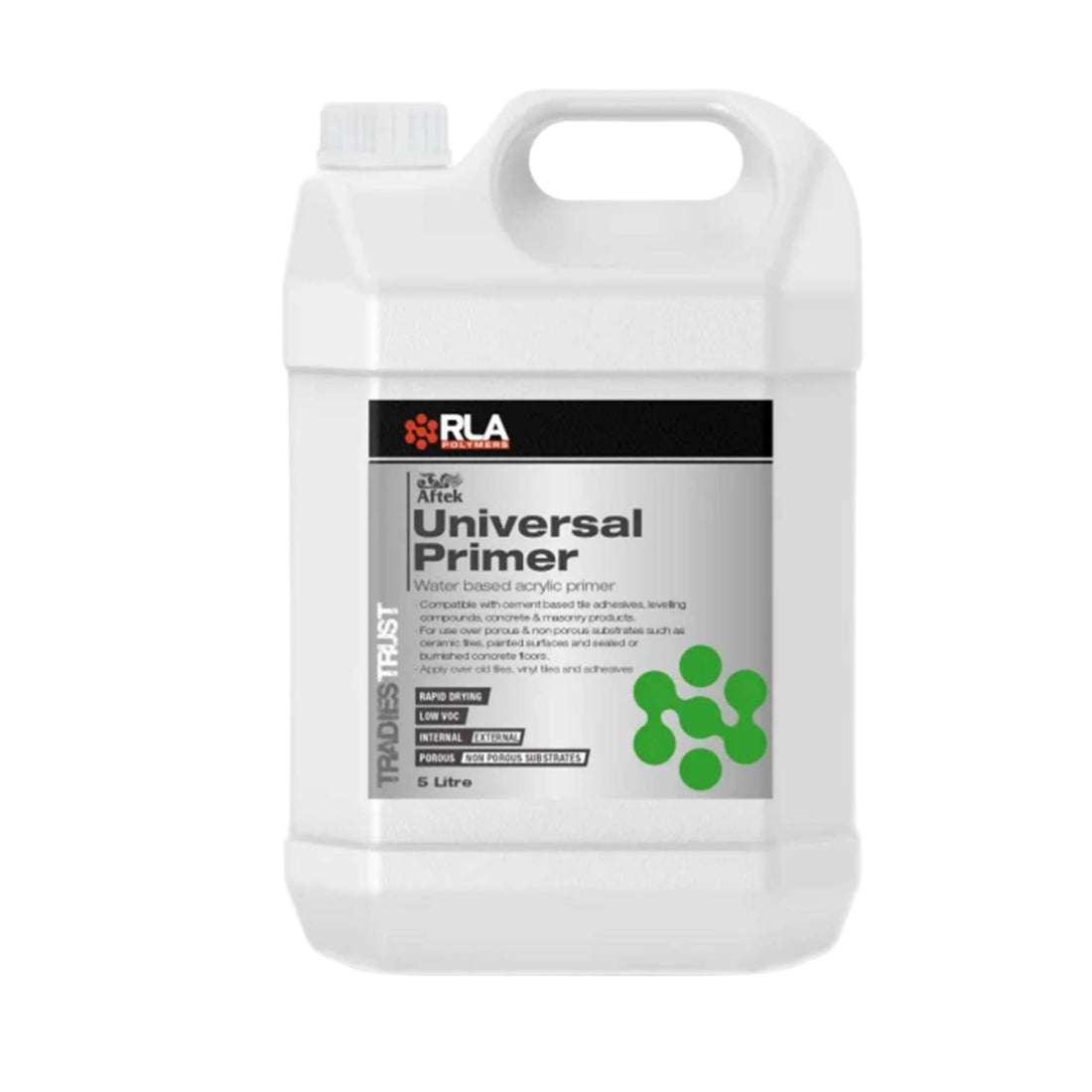
RLA Universal Primer

Trade quote

Custom pricing available

Tell us what you need and we'll come back with a quote.

Custom trade quote

Share your quantity and project details for a tailored quote.

Step 1: Quick quote

Step 2: Business and delivery details

Prepares diverse internal substrates for reliable bonding.
Vendor: RLA
SKU: PRIMEUNI/5
Availability: Out Of Stock
$121.14
$121.14
Prices do not include GST
Shipping & Delivery

Flat-rate shipping $17.95 + GST (metro and standard zones). Excludes remote/regional/high-cost postcodes and certain items (DG, oversized, long-length, or bagged products 15 kg+). If your order includes any of these, we will contact you to arrange additional freight charges. Online purchases only.

Use RLA Universal Primer for: Fast-turnaround priming on porous concrete (dilute 1:2), boosting adhesion on non-porous surfaces like ceramic tiles and burnished concrete (apply neat), and preparing substrates for cement-based tile adhesives & levelling compounds.

RLA Universal Primer: A Technical Overview

RLA Universal Primer is a rapid-drying, low-VOC, water-based acrylic primer designed for both porous and non-porous substrates. On standard concrete, dilute 1 part primer to 2 parts clean water to wet-out pores and control suction, ensuring uniform adhesive/leveller curing. On non-porous surfaces—such as burnished concrete, ceramic tiles, and liquid waterproofing membranes—apply neat to form a transparent, tack-free film that promotes reliable bond of subsequent cement-based products. Typical recoat/over-apply window is 30–60 minutes at 23 °C, supporting efficient sequencing on Australian job sites where temperature and humidity vary.
30–60 min
Typical dry to transparent film at 23 °C

Core Features & Specifications

  • Water-based acrylic, low VOC — safer indoor work and easy water clean-up.
  • Dual-mode priming — dilute 1:2 on standard porous concrete; apply neat on non-porous substrates.
  • Fast turnaround — typically ready for adhesives/levellers in 30–60 minutes at 23 °C.
  • Wide substrate compatibility — concrete, ceramic tiles, liquid membranes, and water-based painted surfaces.
  • Coverage efficiency — approx. 5–10 m²/L depending on substrate absorbency.
  • Supports moisture management workflows — specify a moisture barrier if RH > 75% (ASTM F2170).
  • Professional pack sizes — 5 L and 20 L; 12-month shelf life in unopened containers.

The RLA Universal Primer Advantage

  • Reduced call-backs: predictable bond line on both porous and non-porous substrates.
  • Labour efficiency: short drying window streamlines tiling and levelling schedules.
  • Cleaner jobs: solvent-free, low odour, and water clean-up for indoor applications.
  • System confidence: proven compatibility with cement-based adhesives and levellers.

Proactive Troubleshooting

Scenario: Priming over high-moisture concrete (>75% RH)

Potential Outcome: Adhesive/leveller instability or debonding.

Adheseal Best Practice: Verify RH via in-situ probe (ASTM F2170). If >75% RH, install a compatible moisture barrier before priming.

Scenario: Applying to high-gloss tiles or contaminated surfaces

Potential Outcome: Poor wetting and reduced adhesion of subsequent layers.

Adheseal Best Practice: Do not apply over high-gloss ceramic tile finishes. Degloss, lightly sand where appropriate, and clean thoroughly; ensure the surface is dry, sound and dust-free before priming.

Applications in Practice: Trade Scenarios

For Tilers (On-site Applicator): Over-tiling existing ceramic

The Professional's Challenge

Achieving reliable adhesion when over-tiling glazed ceramic in bathrooms, while keeping program times tight.

The Adheseal Solution: Engineered Certainty in Practice

Clean and degloss tile (light mechanical key if appropriate). Apply primer neat to form a transparent film (≈1 h at 23 °C). Set with a cement-based tile adhesive, following open time guidance.

Best Practice Note

Avoid high-gloss tiles; if present, mechanically degloss to a uniform matte before priming.

For Flooring Contractors (Business Owner): Levelling burnished concrete

The Professional's Challenge

Low-porosity slabs risk bond failure and patchy leveller cure, increasing rectification costs.

The Adheseal Solution: Engineered Certainty in Practice

Lightly sand to promote key; vacuum. Apply primer neat to achieve an even, tack-free film. Pour levelling compound within the recommended window for consistent cure and bond.

Best Practice Note

Confirm slab RH ≤ 75% (in-situ probe). If higher, install a moisture barrier before priming to prevent debonding.

For Builders (Specifier/Coordinator): Standard porous concrete under tiles

The Professional's Challenge

Controlling suction to avoid rapid water loss from the adhesive and inconsistent set.

The Adheseal Solution: Engineered Certainty in Practice

Dilute 1 part primer to 2 parts clean water; apply evenly. On very porous substrates, apply a second coat diluted 1:3 to stabilise the surface before tiling.

Best Practice Note

Use the “water drop” test: if a 10-cent-sized puddle absorbs in <2 minutes, treat as porous.

Frequently asked questions

Can this primer be used on non-porous surfaces like ceramic tiles?

Yes, apply neat (undiluted) to non-porous substrates. Allow 30–60 minutes dry time to a transparent, tack-free film before applying levellers or adhesives. Degloss and clean high-gloss tiles first.

What dilution ratio is needed for standard concrete?

For standard porous concrete, dilute 1 part primer with 2 parts clean water. On very porous concrete, apply a second coat diluted 1:3 to stabilise suction and minimise dusting.

How do I test if a substrate is porous?

Perform a water drop test: place a 10-cent coin sized puddle on the surface. If the water absorbs in less than 2 minutes, treat the surface as porous. If it remains, treat it as non-porous and prime neat.

Does RLA Universal Primer manage high concrete moisture?

No, this primer is not a moisture barrier. If the in-situ relative humidity (ASTM F2170) exceeds 75%, a compatible moisture barrier must be installed before priming to avoid bond issues.

Is this primer suitable for exterior use?

No, RLA Universal Primer is for internal use only. Maintain a minimum subfloor temperature of 10 °C during application to ensure proper film formation and adhesion.

Applications and benefits

Where RLA Universal Primer is used, what it delivers, and who uses it
Application Key benefit Primary trades
Priming porous concrete floors for tiling Controls substrate suction for predictable adhesive cure and strong bond. Tilers, Builders
Improving adhesion on ceramic tiles before overlays Enhances bond to low-porosity surfaces, preventing delamination. Tilers, Remedial
Preparing burnished or steel-trowelled concrete for levelling Creates a reliable film for uniform leveller adhesion and curing. Flooring Contractors
Conditioning liquid waterproofing membranes Ensures strong, compatible bond for subsequent cement-based toppings. Waterproofers, Tilers

Applying RLA Universal Primer: Enhanced Protocols & Best Practices

  1. Assess Substrate & Porosity

    Confirm soundness, dryness, and cleanliness. Perform the water drop test to determine dilution vs. neat application.

    Pro Tip: Verify RH ≤ 75% via in-situ probes (ASTM F2170) before priming.
  2. Surface Preparation

    Remove wax, oil, grease, curing compounds, and dust. Mechanically prepare if required (shot blasting/diamond grinding). Vacuum thoroughly.

    Timing: Proceed when substrate temperature ≥ 10 °C.
  3. Mixing & Dilution

    When diluting, mix primer and clean water thoroughly. Standard concrete: 1:2 (primer:water). Very porous: second coat 1:3.

  4. Application Method

    Porous Substrates

    Apply diluted primer evenly by roller or brush ensuring full coverage. Allow to dry to a transparent film.

    Non-Porous Substrates

    Apply primer neat (undiluted) to achieve a uniform film. Lightly sand extremely non-porous surfaces first to enhance adhesion.

    Timing: Typical dry/overcoat window 30–60 minutes at 23 °C.
    Pro Tip: Coverage ~5–10 m²/L; adjust technique to substrate absorbency to avoid pooling.
  5. Overcoating

    Once the film is tack-free and transparent, apply cement-based adhesives or levelling compounds according to their instructions.

Product limitations

  • Not for: Exterior applications. This primer is formulated for internal use only. Maintain a minimum subfloor temperature of 10 °C during application.
  • Not for: High-gloss ceramic tiles without prior deglossing or mechanical abrasion. The surface requires a mechanical key for optimal adhesion.
  • Not a moisture barrier: If concrete relative humidity (ASTM F2170) exceeds 75%, a separate, compatible moisture barrier must be installed before priming.
  • Not for: Substrate cleaning with solvents or acid etching. Prepare surfaces mechanically and with appropriate cleaning agents if needed.

Safety and handling

Personal protective equipment

Wear suitable gloves, protective clothing, and eye protection. Avoid direct skin and eye contact.

Ventilation

Use in well-ventilated areas. For indoor applications, ensure adequate airflow to dissipate vapours.

First aid

  • Eyes: Rinse cautiously with water for several minutes. Remove contact lenses, if present, and continue rinsing.
  • Skin: Wash with soap and water. Remove contaminated clothing immediately.
  • Inhaled: Move to fresh air. Seek medical attention if experiencing respiratory discomfort.
  • Swallowed: Do not induce vomiting. Give water to drink and contact medical services immediately.

Storage and disposal

Store in a dry area, off the ground, in unopened containers. Shelf life is 12 months. Dispose of waste in accordance with local regulations.

Substrate guide

Correct substrate preparation and primer application prevent bond failures and ensure consistent performance of subsequent layers.

Standard porous concrete

Surface prep: Ensure the surface is clean, sound, dry, and dust-free. Remove all contaminants like oil, grease, or curing compounds. Maintain a minimum subfloor temperature of 10 °C.

Primer: Required. Dilute 1 part primer with 2 parts clean water. Apply evenly by roller or brush and allow 30–60 minutes to dry to a transparent film.

Very porous concrete

Surface prep: As for standard concrete. Vacuum thoroughly after mechanical preparation like shot blasting or diamond grinding if required.

Primer: Required. Apply an initial coat diluted 1 part primer with 2 parts clean water. If suction remains excessive, apply a second coat diluted 1 part primer with 3 parts clean water to stabilise the surface.

Burnished concrete (non-porous)

Surface prep: Lightly sand or abrade the surface to enhance mechanical key. Vacuum all dust thoroughly.

Primer: Required. Apply neat (undiluted). Allow to dry to a clear, tack-free film before overcoating.

Ceramic tiles (not high-gloss)

Surface prep: Clean the surface thoroughly. If tiles are high-gloss, degloss or abrade as needed. Rinse and dry completely.

Primer: Required. Apply neat (undiluted). Allow to dry to a transparent film before applying adhesive or leveller.

Water-based painted surfaces

Surface prep: Confirm the existing coating is water-based, sound, and clean. Lightly abrade glossy surfaces. Remove any flaking paint.

Primer: Optional. For critical adhesion, apply neat (undiluted). A test area is recommended on repaints and aged coatings to verify compatibility and adhesion.

Liquid waterproofing membranes

Surface prep: Ensure the membrane is fully cured, clean, and compatible with the subsequent products to be applied.

Primer: Required. Apply neat (undiluted). Allow a clear, tack-free film to form before applying leveller or adhesive.

RLA Universal Primer Physical Properties

RLA Universal Primer Physical Properties
Property Value
Base Chemistry Water-based acrylic
Initial Cure 30–60 minutes at 23°C to transparent, tack-free film
Application Temperature Internal use only
Humidity Range Maximum 75% RH (ASTM F2170) before priming
Mix Ratio Neat (undiluted) or 1:2 / 1:3 with water
Coverage Rate 5–10 m²/L (dependent on absorbency)
Substrate Compatibility Standard porous concrete, very porous concrete, burnished concrete, ceramic tiles (not high-gloss), water-based painted surfaces, liquid waterproofing membranes
Clean Up Water
VOC Content Low
Packaging 5 L, 20 L
Shelf Life 12 months (unopened)
Storage Conditions Dry area, off the ground

Alternative Products

Need Help with RLA Universal Primer?

Need more information about this product? Hit the button below and reach out to one of our experts now.

Recently Viewed Products

Thanks for subscribing!

This email has been registered!

Shop the look
Choose Options
Edit Option
Compare
Product SKUDescription Collection Availability Product Type Other Details
this is just a warning
Login
Shopping Cart
0 items