






Download Product Data
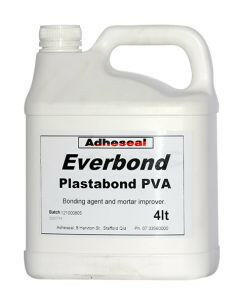
For high-strength mortars, floor screeds, renders, and slurries requiring improved adhesion and durability, Everbond Plastabond PVA acts as a dual-purpose bonding agent and plasticising additive. This polyvinyl acetate resin water dispersion modifies sand, cement, and gypsum mixes to improve chemical resistance and lower water permeability while remaining non-corrosive to steel structural elements.
How it works
Everbond Plastabond PVA modifies the cementitious matrix to produce polymer-modified mortars and renders with increased tensile and mechanical strengths. As an additive, it improves mix elasticity to reduce shrinkage cracking and increases resistance to oil, water, abrasion, and mild chemical attack. When applied directly as a surface bonding agent, it creates a high-adhesion keyway to secure new screeds and concrete pours to existing substrates.
Where to use it
- As an additive: Modifies patching and repair mortars, renders, floor screeds, and slurries to increase bond strength and durability.
- As a bonding agent: Bonds new concrete and toppings to prepared structural surfaces.
- Insulation board installations: Improves the adhesion of cementitious renders when applied directly over insulation boards and lightweight panels.
Limitations
- Polystyrene panels: Do not use Everbond Plastabond PVA for bonding to polystyrene panels. For these substrates, refer to the technical data sheet for acrylic bonding agents.
- Application temperature: Do not apply when substrate or ambient temperatures are below 5°C or above 35°C.
- Curing constraint: When used as a surface bonding agent, the topping concrete must be poured while the applied film is still tacky.
Dilution and application
- As a plasticiser admix: Dilute between 1 part Plastabond to 10 parts water, up to 1 part Plastabond to 1 part water depending on strength requirements. Mix into the concrete or mortar to achieve the desired consistency, typically requiring 7 to 10 litres of the blended liquid per bag of cement.
- As a bonding agent: Dilute 4 parts Plastabond to 1 part water. Apply to the substrate at an approximate coverage rate of 8 square metres per litre. Pour the concrete over the wet film while it remains tacky.
- Clean up: Wash tools and remove uncured material immediately using clean water.
What is Everbond Plastabond used for?
As a PVA bonding agent and plasticising additive for mortars, screeds, renders and repair mixes.
What is the bonding-agent dilution?
4 parts Plastabond to 1 part water.
What coverage should I allow as a bonding coat?
About 8m² per litre.
Can it bond polystyrene panels?
No. Polystyrene bonding is excluded.
- Concrete.
- Cement mortars and renders.
- Floor screeds.
- Masonry and compatible mineral repair substrates.
- Insulation-board render systems approved for PVA modification, excluding polystyrene bonding.
Everbond Plastabond PVA Physical Properties
| Property | Value |
|---|---|
| Material Type | Polyvinyl acetate resin (PVA) |
| Curing System | Water dispersion (evaporation) |
| Density | 1030 kg/m³ |
| Consistency | White liquid (emulsion) |
| Application Temperature | 5°C to 35°C |
| Mixing Ratio | 1:10 to 1:1 (water to adhesive) |
| Coverage Rate | Approximately 8 m²/L as bonding coat |
| Clean Up | Water (while wet), Solvent (when cured) |
| VOC Content | N/A (water-based) |
| Shelf Life | 12 months (in original unopened packaging) |
| Storage Conditions | Store in a cool, Dry place between 10°C and 35°C |
| Specific Gravity | 1.03 |