







Download Product Data
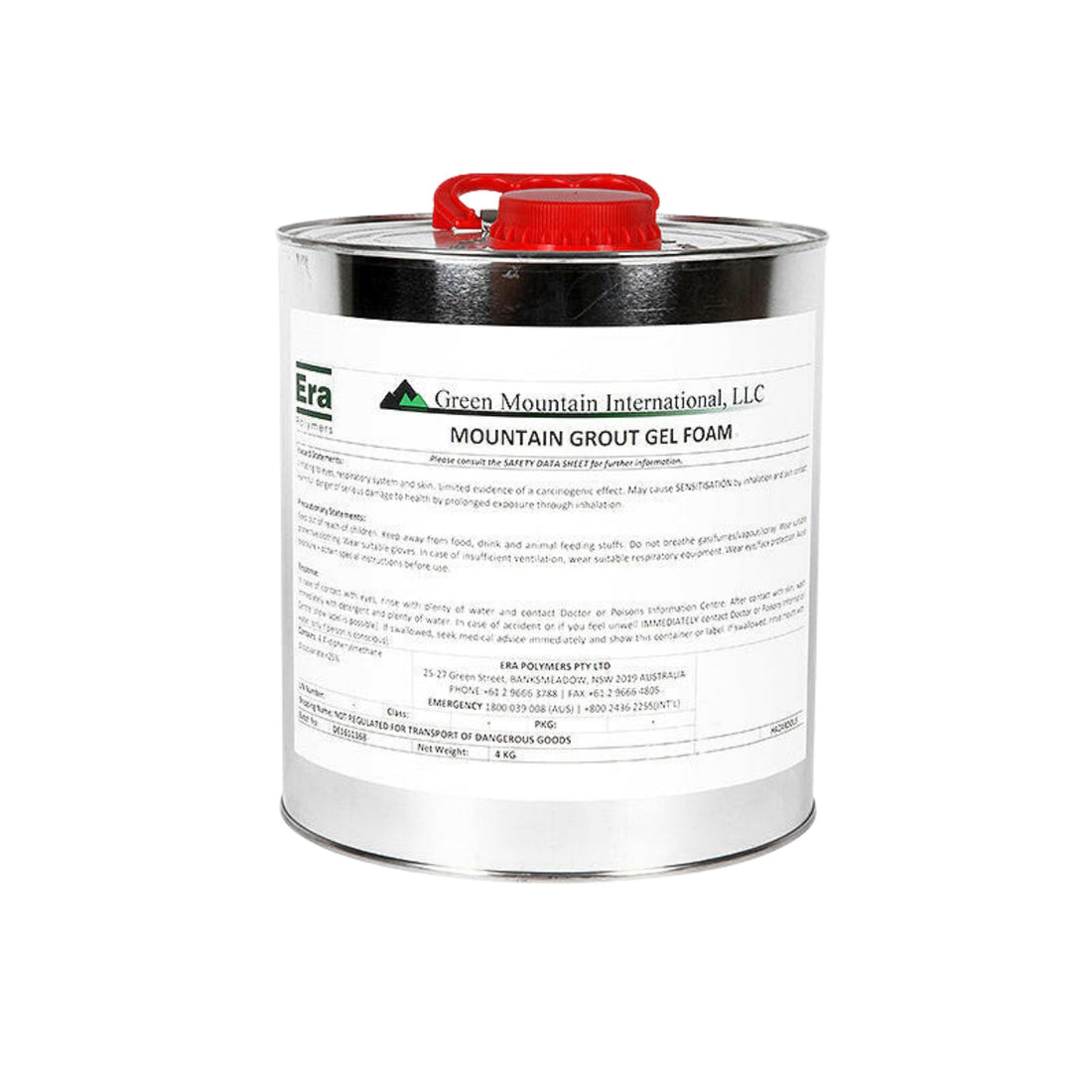
For sealing leaking cracks or joints in concrete structures with continuous moisture exposure, Mountain Grout Gel Foam is a hydrophilic polyurethane formulation that reacts with water to stop active leaks. The single-component system is formulated without TDI or solvents, reacting directly with the water it encounters inside the concrete to create either a foam or a gel barrier depending on the moisture volume present.
How it works
Mountain Grout Gel Foam can be pumped as a single component directly into wet concrete cracks, or injected as a dual-component system alongside water. Upon contact with water, the liquid expands up to 25 times its initial volume to fill voids and seal paths of water ingress. Because the formulation is hydrophilic, it requires continuous moisture exposure to maintain its physical seal, curing into an inert, non-toxic barrier that handles ongoing structural movement without losing adhesion.
Where to use it
- Concrete dams and tunnels experiencing water ingress
- Storm water systems and waste treatment plants
- Underground vaults, elevator pits, and water-related facilities
Numbers that matter
- 400% elongation (ASTM D-638): High elasticity allows the cured gel-foam to stretch and flex with moving concrete joints and cracks without shearing the bond.
- 650 cps viscosity (ASTM D-1638): Low viscosity allows the liquid grout to penetrate deep into fine cracks and fissures before reaction begins.
- 30-second initiation time: Rapid start to the reaction when mixed at a 1:1 ratio with water at 25ºC, reaching full rise in approximately 6 minutes to choke off active water flows.
- 170 psi tensile strength (ASTM D-638): Provides the mechanical strength necessary to withstand hydrostatic pressures in underground vaults and pits.
Limitations
- Formulated for concrete structures with continuous moisture exposure; requires water to react and ongoing moisture to maintain its seal performance.
When should Gel Foam be chosen instead of a hydrophobic Mountain Grout?
Choose Gel Foam where the crack or joint remains continuously wet. Its hydrophilic seal relies on ongoing moisture; for wet/dry cycling, use a suitable hydrophobic grout instead.
- Wet concrete cracks
- Concrete joints with continuous moisture exposure
- Water-bearing voids in concrete structures
Mountain Grout Gel Foam Physical Properties
| Property | Value |
|---|---|
| Base Chemistry | Hydrophilic Polyurethane |
| Curing System | Single Component |
| Viscosity | 650 cps |
| Elongation | 400% |
| Expansion Ratio | Up to 25x |
| VOC Content | 0 |
| Solid Content | 100% |
| Specific Gravity | 1.07 |
| Flash Point | >121ºC |
| Density | 80kg/m³ |
| Tensile Strength | 170 psi |