
Skip to content
🚛 Flat Rate Shipping $17.95+ GST For Metro & standard delivery zones! Excludes remote/regional and high-cost postcodes (including parts of QLD, WA, NT & TAS), and bulky or heavy items. Online only. Learn More

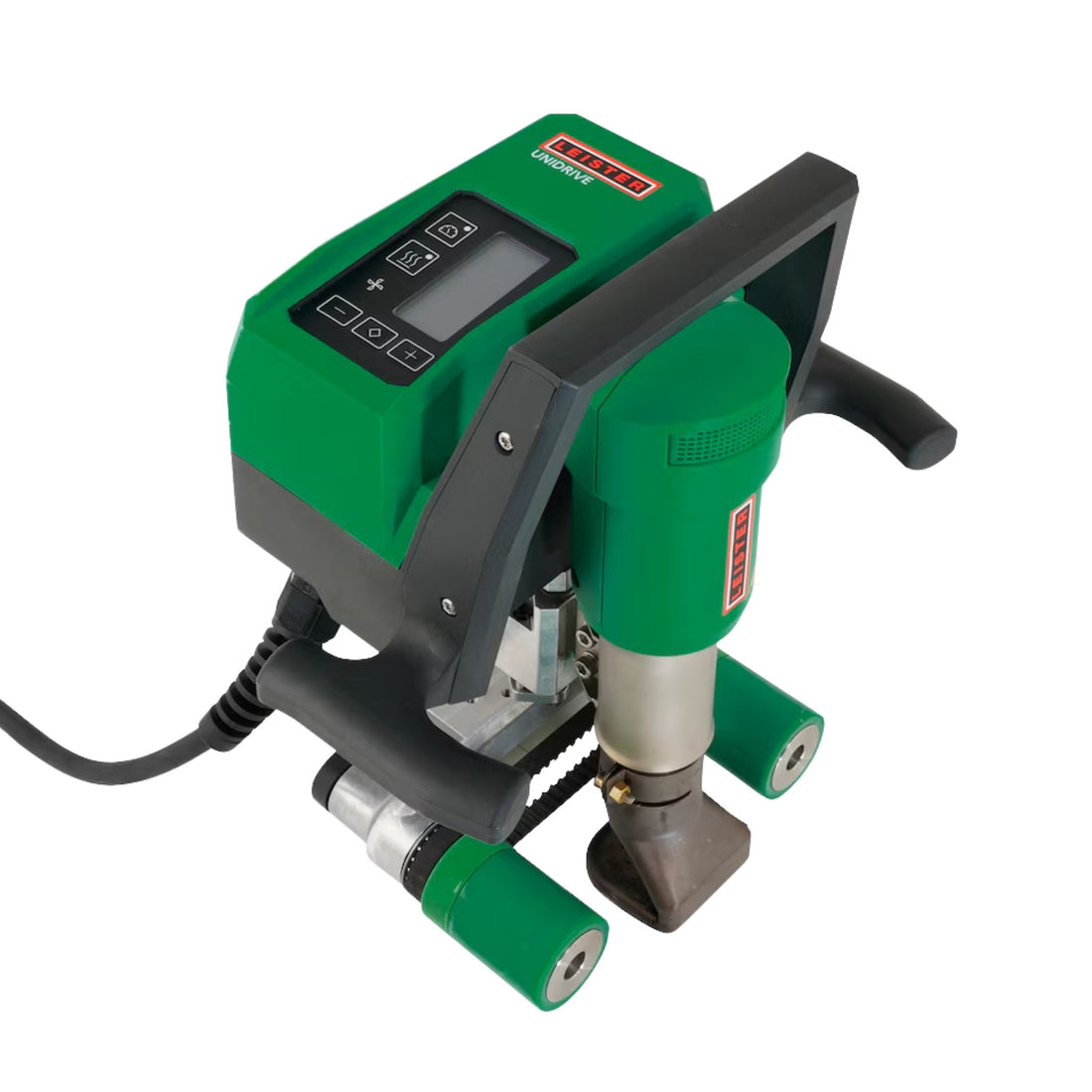
Leister UNIDRIVE 500 Semi-Automatic Welding Machine

Trade quote

Custom pricing available

Tell us what you need and we'll come back with a quote.

Custom trade quote

Share your quantity and project details for a tailored quote.

Step 1: Quick quote

Step 2: Business and delivery details

Semi-automatic hot air welder for reliable, high-speed fusion of thermoplastic roofing and waterproofing membranes.
Vendor: Leister
SKU: FATRAUNIDRIVE
Availability: Out Of Stock
$10,179.60
$10,179.60
Prices do not include GST
Shipping & Delivery

Flat-rate shipping $17.95 + GST (metro and standard zones). Excludes remote/regional/high-cost postcodes and certain items (DG, oversized, long-length, or bagged products 15 kg+). If your order includes any of these, we will contact you to arrange additional freight charges. Online purchases only.

Use Leister UNIDRIVE 500 for: Fast, consistent welding on small roofs, skylight flashings, edge terminations, and compact detailing jobs where manual welding is slow or inconsistent.

Leister UNIDRIVE 500: A Technical Overview

The Leister UNIDRIVE 500 redefines efficiency in plastic welding by combining the precision of automatic control with the manoeuvrability of manual tools. With its lightweight 4.5 kg frame and ergonomic handle, it delivers consistent weld pressure even on challenging angles and edge details. The adjustable air volume and temperature (100–580 °C) allow tailored settings across membrane types such as TPO, PVC, FPO, and EPDM. Its reversible drive function enables welding in both directions—perfect for confined or intricate areas. Designed with brushless motors for long service life, and supported by a digital display for precise parameter control, it ensures repeatable quality every time.

Core Features & Specifications

  • Up to 4.5 m/min welding speed — up to three times faster than manual welding, reducing labour time
  • Welding temperature range from 100–580 °C for broad compatibility with roofing membranes
  • Reversible drive enables forward and backward operation for tight or mirrored layouts
  • 15–40 mm seam width capability using interchangeable nozzles for varied job requirements
  • Ergonomic handle and compact form factor for excellent control in edge or vertical applications
  • Brushless blower and drive motors ensure high durability with minimal maintenance
  • Digital display for consistent, repeatable settings and real-time quality assurance
  • CE, UKCA, and CB certified with Class I protection and Swiss manufacturing quality

The Leister UNIDRIVE 500 Advantage

  • Delivers professional consistency across variable substrates and angles
  • Minimises fatigue and enhances speed on detailing work and small-scale roofing
  • Reduces risk of burn-through or underheating with precision digital control
  • Compact and agile — no need for large automatic welders on tight jobs
  • Replaces manual welding for up to 70% faster throughput on small flat roofs

Proactive Troubleshooting

Scenario: Inconsistent welds on vertical or edge detailing

Potential Outcome: Weak seals, water ingress or delamination under movement stress

Adheseal Best Practice: Use the UNIDRIVE 500’s ergonomic grip and forward/reverse drive mode to maintain consistent pressure on vertical seams. Monitor digital readouts to avoid overheating thinner materials.

Scenario: Overheating membranes on slower passes

Potential Outcome: Membrane distortion, loss of structural integrity, or unsightly weld beads

Adheseal Best Practice: Calibrate the air temperature based on material type. Start at 400 °C for PVC and adjust with test welds. Avoid remaining stationary during heating.

Applications in Practice: Trade Scenarios

For Roofers (On-site Applicator): Speed and Consistency on Small Flat Roofs

The Professional's Challenge

Small terrace roofs and skylight flashings often require precision detailing and speed. Manual welds are slow and difficult to control evenly—especially in warm Australian climates where membrane softening risks damage.

The Adheseal Solution: Engineered Certainty in Practice

The UNIDRIVE 500 delivers uniform welds up to 4.5 m/min and allows forward or reverse passes for mirrored detailing. The digital display ensures reliable repeat settings for PVC, TPO, or EPDM membranes.

Best Practice Note

Perform a material pre-test on offcuts to confirm air volume and temperature before starting live welds. Use 30 mm or 40 mm nozzle widths depending on membrane overlap.

For Maintenance Contractors (Business Owner): Rapid Detail Repairs Without Sacrificing Quality

The Professional's Challenge

Time is money—especially when responding to leak repairs or detailing work on existing roofs. Bulky hot-air equipment is cumbersome and overkill for small areas.

The Adheseal Solution: Engineered Certainty in Practice

The lightweight UNIDRIVE 500 delivers professional welds with minimal setup. Reversible drive and ergonomic design allow single-tool access even in tight corners, reducing call-backs.

Best Practice Note

Carry both 15 mm and 40 mm nozzle setups in your vehicle to match repair conditions. The 3 m cable provides ample reach for mobile repair use without needing extension leads.

Frequently asked questions

Can the UNIDRIVE 500 weld in both directions?

Yes, the reversible drive function allows welding from left-to-right or right-to-left. This feature simplifies work in tight spaces or when matching mirrored details, reducing the need to reposition the tool or the operator.

What types of membranes can the UNIDRIVE 500 weld?

It is designed for thermoplastic roofing membranes including PVC, TPO, FPO, EPDM, EVA, ECB, PU, TPU, and TPE. Always verify compatibility and specific welding parameters with the membrane manufacturer's technical data sheet.

What is the advantage of brushless motors in this machine?

Brushless motors for both drive and blower extend the service life of the machine and reduce maintenance requirements. They also deliver more consistent performance, crucial for demanding, continuous welding applications on-site.

What nozzle widths does the UNIDRIVE 500 support?

The machine accommodates nozzle widths ranging from 15 mm to 40 mm. Narrower nozzles are used for intricate detailing, while wider nozzles are suitable for main seam runs, balancing precision and speed.

Applications and benefits

Where Leister UNIDRIVE 500 Semi-Automatic Welding Machine is used, what it delivers, and who uses it
Application Key benefit Primary trades
Welding small to medium flat roof membranes (PVC, TPO, FPO) Delivers consistent, verifiable seams at up to 4.5 m/min, improving productivity over manual methods. Roofers, Waterproofers
Skylight, parapet, and edge detailing Reversible drive and precise heat control allow for ergonomic, mirrored welding access in complex areas. Roofers, Maintenance Contractors
Vertical surface terminations and upstands Compact design and ergonomic grip support stable, controlled welding on high-angle or vertical elements. Roofers, Facade Installers
Membrane repairs and overlays Lightweight construction and brushless motors enhance portability, making it suitable for reactive and mobile repair jobs. Remedial Contractors, Commercial Builders

Applying Leister UNIDRIVE 500: Enhanced Protocols & Best Practices

  1. Surface Preparation

    Ensure all substrates are clean, dry, and free from dust, oils, or membrane chalking. Contaminated or aged membranes may require wiping with a suitable cleaner and mechanical scrubbing.

    Manual Wipe-Down

    Use lint-free cloths and compatible surface prep agents such as Adheseal Surface Prep or IPA (isopropyl alcohol). Always allow solvent to evaporate before proceeding.

    Mechanical Prep

    On weathered substrates, lightly abrade the surface using a Scotch-Brite pad to improve fusion. Wipe clean after abrasion.

    Timing: Perform surface prep immediately before welding. Avoid leaving cleaned surfaces exposed for long periods.
    Pro Tip: Always conduct a test weld on membrane offcuts after surface prep to confirm performance.
  2. Machine Setup

    Connect the unit to power and configure settings based on membrane type and job conditions. Use the digital display to set the temperature, speed, and airflow volume.

    TPO/PVC Setup

    Start with 480–520 °C temperature, 3.0 m/min speed, and 60–80% airflow. Adjust after observing test weld quality.

    EPDM & EVA Setup

    Use higher temperatures up to 550 °C and slower speeds (1.5–2.0 m/min) depending on membrane thickness and substrate.

    Timing: Let the unit preheat for 1–2 minutes before initiating welding.
    Pro Tip: Save successful parameter combinations for reuse to ensure repeatable quality across jobs.
  3. Welding Process

    Insert the welding nozzle into the overlap and start the drive motor in the selected direction. Maintain steady pace and let the tool do the work. Do not push or tilt the machine during operation.

    Forward Welding

    For standard runs from left to right. Align nozzle with seam overlap and engage drive smoothly.

    Reverse Welding

    For mirrored edge runs or right-to-left detailing. Toggle direction via control button on handle.

    Timing: Welding duration varies based on speed and seam length. A 2 m seam typically takes under 1 minute.
    Pro Tip: Use a silicone roller to quickly consolidate seams during cooling for extra bond strength on curved sections.

Product limitations

  • Not for: Non-thermoplastic membranes such as bitumen or modified bitumen-based materials. These materials require different welding technologies.
  • Operation: Requires experienced and trained personnel for consistent, high-quality welds, particularly on complex details or vertical surfaces. It is not suitable for untrained users.
  • Ventilation: Indoor use necessitates adequate ventilation to manage heat generation and potential fume release from heated membrane surfaces.

Safety and handling

Personal protective equipment

Wear heat-resistant gloves and eye protection during operation. Long-sleeve cotton clothing is recommended to protect against radiant heat from the hot air nozzle.

Ventilation

Operate the machine in well-ventilated areas, especially when working indoors or with membranes like PVC and TPO that may release vapours when heated.

First aid

  • Eyes: Flush with clean water for at least 15 minutes if contact with vapours or particles occurs. Seek immediate medical attention.
  • Skin: For burns, cool the affected area immediately with running water. Do not apply ointments. Seek medical advice for severe burns.
  • Inhaled: Move to fresh air. If breathing difficulties occur, seek medical assistance.

Storage and disposal

Store the unit in a dry, protected environment. Allow the machine to cool completely before storage. Do not rest the hot nozzle on any surface at any time.

Substrate guide

Proper surface preparation is essential for reliable welding and seam integrity. This guide details key steps for common thermoplastic membranes.

TPO & FPO membranes

Surface prep: Ensure surfaces are dry, clean, and free of dust, debris, and any chalking. If contamination is present, clean with a manufacturer-approved cleaner. Inspect older TPO membranes for surface oxidisation and address as required.

Primer: Not required. For most new membranes, direct welding is sufficient after proper cleaning. Pre-cleaning is critical for consistent bonding on weathered surfaces.

PVC roofing membranes

Surface prep: Clean seams and overlaps thoroughly with lint-free cloths and an approved PVC membrane cleaner. Avoid using aggressive solvents that could soften the membrane prematurely. Ensure no rainwater residue remains, and de-gloss where necessary to improve fusion.

Primer: Not required. The UNIDRIVE 500 directly welds clean, prepared PVC surfaces.

EPDM & PIB membranes

Surface prep: Clean surfaces to remove talc, dust, or carbonised material using an EPDM-approved cleaner. Allow the cleaner to evaporate completely before welding.

Primer: Required for critical applications. When welding EPDM or PIB membranes, particularly for detailing or non-homogeneous areas, a hot-bonding primer designed for EPDM is necessary to achieve a reliable bond.

EVA, TPU & PU membranes

Surface prep: Wipe surfaces with isopropyl alcohol to remove any oils or contaminants. Allow adequate drying time before commencing any welding. Always perform a test weld on an offcut first.

Primer: Recommended for optimal adhesion. On aged substrates or those with high movement potential, a polyurethane-compatible primer can improve long-term bond integrity.

Leister UNIDRIVE 500 Semi-Automatic Welding Machine Physical Properties

Leister UNIDRIVE 500 Semi-Automatic Welding Machine Physical Properties
Property Value
Application Temperature 100°C to 580°C
Power Consumption 1500–2300 W
Weight 4.5 kg
Welding Speed 0.7–4.5 m/min
Nozzle Width Range 15 mm to 40 mm
Length 297.0 mm
Width 173.0 mm
Compatible Membranes ECB, EPDM, EVA, FPO, PIB, PO, PU, PVC, TPE, TPO, TPU
Electrical Classification Class I
Certifications CB Certification, CE, UKCA

Alternative Products

Need Help with Leister UNIDRIVE 500 Semi-Automatic Welding Machine?

Need more information about this product? Hit the button below and reach out to one of our experts now.

Recently Viewed Products

Thanks for subscribing!

This email has been registered!

Shop the look
Choose Options
Edit Option
Compare
Product SKUDescription Collection Availability Product Type Other Details
this is just a warning
Login
Shopping Cart
0 items